Why Is Ola Electric Share Price Falling? The Full Story Behind The Crash And Recovery In 2026
Why Is Ola Electric Share Price Falling
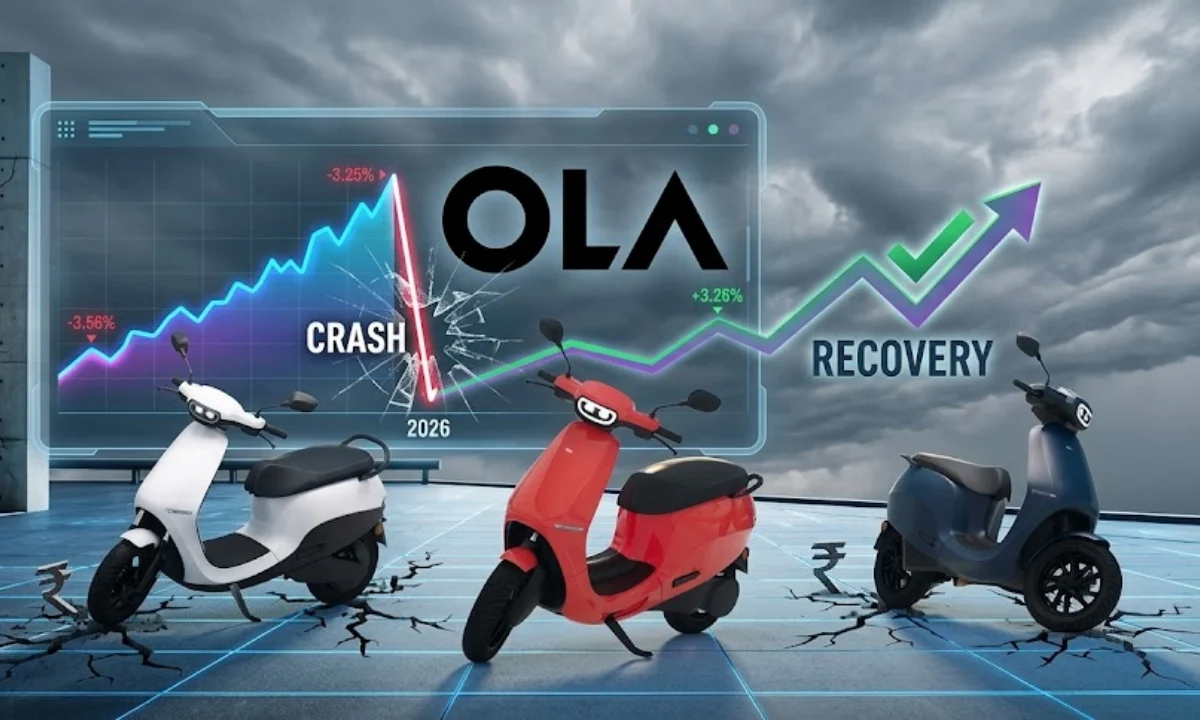
If you have been watching Ola Electric Mobility’s stock in recent months, you have seen one of the most dramatic stories in Indian stock market history. From a post-listing high of ₹157.5 per share to an all-time low of ₹21.21 in March 2026, the stock lost nearly 85% of its value in just a few months. That is a wealth erosion of close to ₹9,000 crore in market capitalisation.
Then something changed. In April 2026, the stock suddenly bounced back by over 70%. Investors who had written off the company started paying attention again.
So what actually happened? Why did Ola Electric fall so hard? And is this recent recovery real or is it just a temporary bounce?
Table of Contents
A Quick Timeline Of What Happened
Ola Electric made its stock market debut in August 2024 at an issue price of ₹76 per share. The stock initially attracted strong interest as one of India’s first pure-play electric vehicle companies to list on the exchanges. It reached a post-listing high of ₹157.5 per share.
Then the slide began. From October 2024 onwards, the stock fell for six consecutive months. By March 16, 2026, it had hit an all-time low of ₹21.21 per share. That means someone who bought at the post-listing peak had lost 85% of their investment.
In April 2026, the stock started recovering sharply. It rose 71% from its record low within a few weeks. As of the time of this article being written, the stock was trading around ₹36 per share, which is still more than 50% below its IPO issue price of ₹76.
Why Did Ola Electric Share Price Fall So Much?
The fall was not caused by one single event. It was a combination of business problems that built up over time. Here are the real reasons behind the crash.
Weak Sales And Falling Demand
The most visible problem was poor sales numbers. When a high-growth company like Ola Electric starts showing declining volumes, it sends a strong negative signal to the market.
Vehicle registrations dropped sharply. February 2026 registrations were just 3,973 units. For a company that went public on the promise of disrupting India’s two-wheeler market, numbers like these were deeply disappointing for investors who had bet on rapid growth.
When a company trades at a high valuation based on future growth expectations, weak sales numbers cause the stock to fall much harder than it would for a traditional company. Ola Electric was priced for aggressive growth. The numbers were not delivering that growth.
Rising Losses And Heavy Cash Burn
This is where the fundamental problem becomes clear.
In Q3 FY26, Ola Electric reported revenue of approximately ₹470 crore. But it also reported a net loss of approximately ₹487 crore. That means the company was losing almost as much money as it was earning in revenue.
For a growth company, some losses are expected and even acceptable in early years. But when losses keep widening even as revenue growth slows, it raises serious questions about whether the business model can ever become profitable.
Investors and analysts started asking how long Ola Electric could sustain this level of cash burn without raising more capital or generating positive cash flow.
Falling Market Share In The EV Segment
Ola Electric was once the dominant player in India’s electric two-wheeler market. But that dominance started eroding as competition intensified.
Bajaj Auto and TVS Motor Company made significant progress in the EV segment. Both companies have strong manufacturing expertise, wide dealer networks, and trusted brand names built over decades. When they started offering competitive electric two-wheelers, buyers who might have chosen Ola started considering alternatives.
Ola’s market share in the electric scooter segment declined visibly. For a company whose entire valuation story depends on being the leader in India’s EV revolution, losing market share to established rivals was a serious concern.
Service Quality Problems And Customer Trust Issues
This is the factor that most financial news articles underplay. But it was one of the biggest reasons why Ola Electric’s reputation suffered.
Customers reported significant problems with after-sales service. Complaints about long waiting times for service appointments, spare parts not being available, and quality issues after servicing circulated widely on social media. Negative word-of-mouth spread fast. For a company selling premium electric vehicles on the promise of a better ownership experience, these service failures damaged customer confidence severely.
When existing customers complain publicly and new buyers hear those complaints, it affects demand. Reduced demand affects sales numbers. Weak sales affect the stock price. It becomes a cycle that is hard to break quickly.
Corporate Governance Concerns
Several analysts raised concerns about governance issues at Ola Electric. These included questions about transparency in operations, inventory management practices, and questions around the usage of funds raised through the IPO.
Even the company’s auditors flagged certain issues. When auditors raise concerns, it is a serious signal for institutional investors who place high value on governance standards.
These concerns did not directly cause the stock to crash in isolation. But they added to the general sense of uncertainty around the company’s management and execution quality.
High IPO Valuations Meeting Hard Reality
When Ola Electric listed at ₹76 per share, it was already priced at a very high valuation relative to its current financials. That high valuation was justified by expectations of explosive growth, improving margins, and a clear path to profitability.
When the actual numbers started coming in below expectations, the gap between what investors had priced in and what the company was actually delivering became very wide. That gap closed painfully through the stock price falling sharply.
This is a common pattern with new-age tech and EV companies. High listing enthusiasm followed by a dose of reality as quarterly results come in.
Why Is The Stock Rising Now?
After touching its all-time low in March 2026, something changed. The stock rose over 70% in April. Here is what drove that recovery.
March Sales Data Showed A Dramatic Improvement
The single biggest trigger for the recovery was March 2026 sales data.
| Month | Vehicle Registrations |
|---|---|
| February 2026 | 3,973 units |
| March 2026 | 10,117 units |
That is a jump of more than 150% in just one month. Daily orders in the last week of March crossed 1,000 units per day. The market interpreted this as evidence that demand had not collapsed permanently and that the company could still bounce back.
Service Quality Improvements
Ola Electric announced that over 80% of vehicles are now being serviced on the same day. This is a direct response to one of the biggest complaints customers had raised. If the company can sustain this service quality improvement consistently, it addresses one of the core reasons that damaged customer trust.
Price Cuts And Aggressive Strategy
Ola Electric reduced the price of its Roadster 9.1 model by ₹60,000, bringing it down to ₹1.3 lakh. It also launched its EndICEAge series with prices starting from ₹49,999, along with buyback guarantees and other benefits.
These price cuts are designed to attract price-sensitive buyers and help Ola recover market share. The electric two-wheeler market in India is very price sensitive. Lower prices can meaningfully drive volumes. The cuts were made possible by the company ramping up production of its in-house 4680 Bharat Cell, which has brought down manufacturing costs.
New Battery Technology Announcement
Ola Electric announced that its newly developed Lithium Iron Phosphate (LFP) cell is ready. This is their 46100 format cell which is larger than the current NMC 4680 Bharat Cell. The company said it represents a meaningful improvement in scale, cost efficiency, and applicability across both vehicle and energy storage applications. This cell is expected to enter Ola’s products from the next quarter.
LFP chemistry is generally considered safer, longer-lasting, and cheaper than the NMC chemistry currently used. This development signals that Ola is making genuine progress on its vertical integration goals. Investors reacted positively.
Gigafactory Expansion
Ola is accelerating expansion of its Gigafactory with capacity scaling toward 6 GWh. Greater manufacturing capacity means lower per-unit costs through economies of scale. This is central to Ola’s long-term strategy of making EVs affordable while improving its own margins.
What Analysts Are Saying Right Now
Expert opinion on Ola Electric is divided but generally cautious.
Kranthi Bathini of WealthMills Securities noted that the announcement of an India-made lithium-ion battery is positive from a long-term perspective and that EV adoption could accelerate with rising global crude oil prices. However, he added clearly that the stock is suitable only for investors with a high risk appetite.
Osho Krishan of Angel One described the 20% surge as backed by strong volumes indicating reversal signals. But he also warned that the stock is still below its 200-day moving average and that caution is advisable with stop losses in the ₹30 to ₹33 range.
Vinit Bolinjkar of Ventura described the current situation as a shift from a “crisis” phase to a “show-me” phase. He said the stock still faces fundamental hurdles around profitability and debt management. He also noted that at least two more months of consistent high-volume registrations are needed before concluding that this is not just a dead cat bounce.
Abhinav Tiwari of Bonanza pointed out that price cuts can push volumes in the near term but aggressive discounting alone will not solve the profitability problem.
The consensus view from analysts is that the worst technical selling may be over but the fundamental challenges have not been resolved yet.
Is This Recovery Real Or Just A Temporary Bounce?
This is the most important question for investors.
The recovery has real triggers behind it. The March sales jump is a genuine data point. The service improvement is a real operational change. The battery technology development is a meaningful milestone.
But one good month is not a turnaround. For the recovery to be confirmed as sustainable, investors need to see consistent sales improvement across April, May, and June 2026. The company needs to show a clear trajectory toward reducing its quarterly losses. Service quality improvements need to be maintained at scale across a growing customer base.
Competition is not going away. Bajaj and TVS are continuing to invest aggressively in their EV portfolios. Ola no longer has the segment to itself.
Corporate governance concerns have not been fully resolved. These take time to rebuild and require sustained transparent communication from management.
The stock is still trading at more than 50% below its IPO issue price. While that represents a significant discount from its highs, the fundamental question of whether Ola Electric can build a profitable business at scale has not been answered yet.
Should You Buy Ola Electric Shares Right Now?
The answer depends entirely on your risk appetite and investment time horizon.
Ola Electric is a high-risk high-reward situation. For long-term investors who believe in the EV growth story in India and are comfortable holding through volatility, the current price level could represent an interesting entry point compared to the highs. The vertical integration strategy with in-house battery manufacturing is a genuine long-term competitive advantage if executed well.
For average retail investors who cannot afford to lose a significant portion of their investment, the safer approach is to wait for at least 2 to 3 months of consistent data. Watch the April and May 2026 registration numbers. Watch whether the quarterly loss narrows in the next results. Watch whether service quality improvements are sustained.
One positive month after six bad ones is not enough to confirm a full recovery.
Do not make investment decisions based on price movement alone. A stock rising 70% from its lows is exciting. But it is only meaningful if the underlying business fundamentals are actually improving in a sustainable way.
Related Posts :



Share This Post