The Hidden Meaning Behind Amin, The Virus And The Final Storm: Alpha 2025 Ending Explained

The Hidden Meaning Behind Amin, The Virus & The Final Storm: Alpha 2025 Ending Explained | Image Via IMDB.com
If you watched Alpha (2025) & reached the ending scene with the red dust storm, chances are you left confused. The film jumps between timelines, mixes memories with reality and slowly reveals the emotional trauma hidden behind the story. Many viewers are asking the same question online: what actually happened in the ending of Alpha 2025?
At first the film move looks like a body horror story about a strange virus that slowly turns people into marble statues. But as the story goes ahed it becomes clear that there is much more going on beneath the surface.
In this blog post we are going to see the whole story of Alpha movie & also explain the ending along with the real reactions of people who watched this movie.. So Keep Reading
Table of Contents

Key Takeaways On Alpha 2025 Story
- Alpha 2025 uses a mysterious virus as a metaphor for social stigma and fear
- The film moves between two timelines connected through Alpha’s childhood trauma
- Amin’s presence in the present timeline is likely a manifestation of memory and guilt
- The ending focuses on acceptance of loss rather than curing the disease
- Alpha symbolically breaks the cycle of generational trauma in the final scene
- The red dust storm represents closure and emotional release
Alpha 2025 Plot Summary In Simple Terms
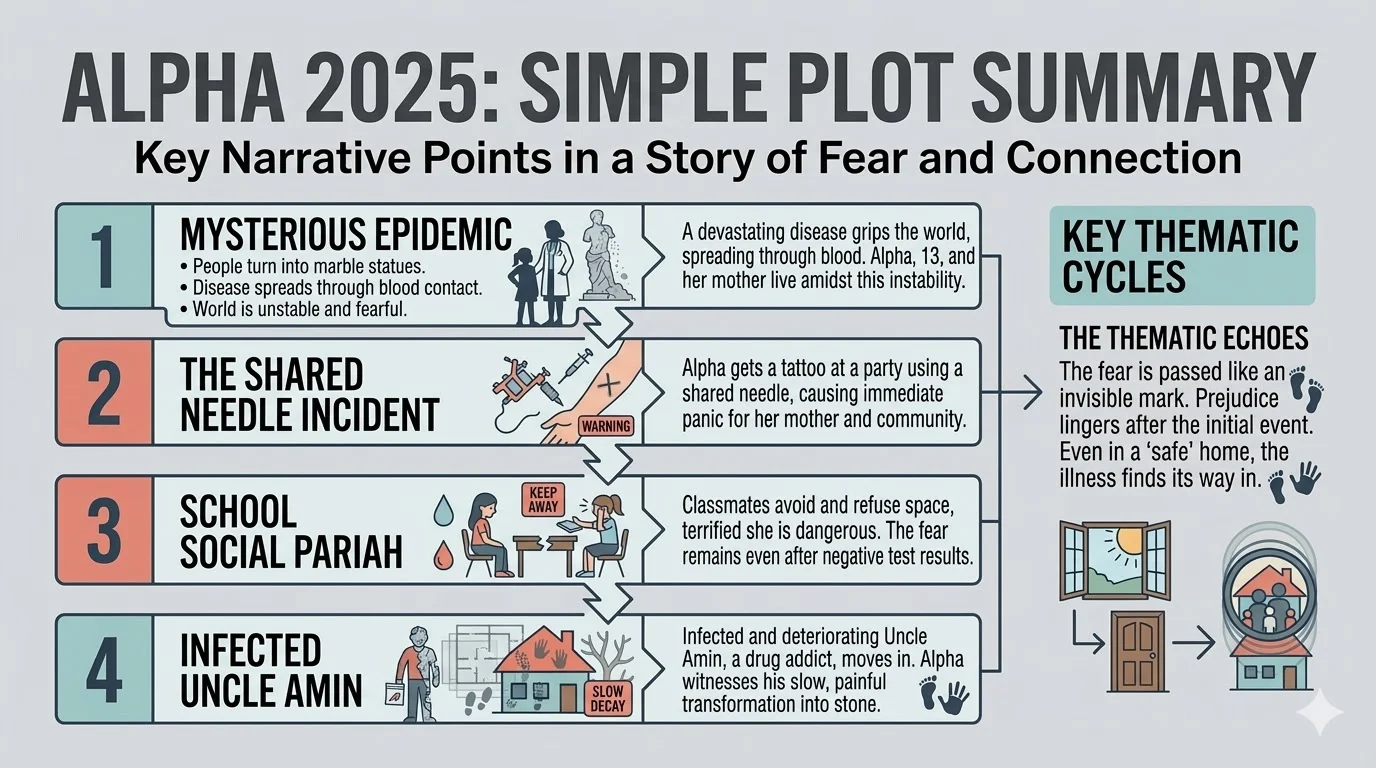
The story follows 13 year old Alpha, a rebellious teenager living with her single mother who works as a doctor. Their world is already unstable because of a mysterious epidemic. People infected with the disease slowly turn into marble statues before eventually turning into dust.
The trouble begins when Alpha attends a party and gets a crude tattoo using a shared needle. In a world where the disease spreads through blood contact, this immediately causes panic. Her mother becomes terrified that Alpha may have been infected.
While waiting for the test results, Alpha faces heavy bullying at school. Her classmates treat her like she is dangerous. They avoid touching her, refuse to share space with her and even panic when she starts bleeding. Even though the test later shows she is not infected, the fear around her never fully disappears.
During this stressful time, Alpha’s uncle Amin suddenly appears and begins living with them. Amin is a drug addict who is already infected with the disease. His condition slowly worsens and Alpha begins to understand the suffering of those who are infected.
But the film later reveals something surprising about Amin’s presence.

Understanding The Virus & Its Real Meaning
As we first look the disease in Alpha looks like a fictional epidemic. Victims slowly turn into marble sculptures before collapsing into dust. The imagery is disturbing but also strangely poetic.
However many viewers and critics noticed that the virus works more like a symbolic element rather than a realistic illness.
The disease spreads mainly through blood and shared needles. Because of this, the story strongly mirrors the fear and stigma that surrounded the HIV and AIDS crisis during the 1980s and 1990s.
People infected in the film are treated as social outcasts. They are feared, isolated and often abandoned by society. Even healthy people like Alpha face discrimination simply because they might be infected.
This element of the story highlights how panic and misinformation can cause society to reject vulnerable people.
Alpha’s Experience With Social Stigma
One of the strongest parts of the film is Alpha’s experience at school. The moment her classmates think she might be infected, everything changes.
Her friends become distant. Teachers start treating her differently. Students refuse to share the same space with her. In some scenes she is even chased or threatened. The situation shows how quickly fear can turn into cruelty.
Alpha reacts to this by becoming more rebellious. She starts acting aggressively and refuses to behave like a victim. Her actions reflect the frustration of someone who knows she is being judged unfairly. This part of the story connects the audience with the emotional cost of social stigma.
Who Is Amin And Why He Is Important?
Amin plays one of the most emotional roles in the film. He is Alpha’s uncle and a drug addict who contracted the mysterious disease years earlier.
When he arrives at Alpha’s home, he looks weak and physically broken. Despite his condition, he develops a strong bond with Alpha. Their relationship shows a rare sense of understanding between someone who is sick and someone who is learning about the world.
However the film later reveals that the timeline is not straightforward.
The story jumps between past and present events. Slowly the audience realizes that Amin actually died years earlier. His appearance in the present timeline is not real in a physical sense. Instead his presence represents the unresolved trauma shared by Alpha and her mother.
Alpha’s mother never truly accepted her brother’s death. Her guilt and grief created a psychological space where Amin still exists.
Why The Timelines Merge In The Ending
Throughout the film, scenes from the past and present begin to blend together. At first it looks confusing. But the merging timelines actually reveal how trauma affects memory.
Alpha was very young when Amin was dying. She witnessed his suffering and the emotional breakdown of her mother. These experiences stayed buried in her mind.
When Alpha fears she might be infected with the same disease, those memories resurface. Her mother’s anxiety also intensifies. She becomes extremely protective and paranoid. The possibility of losing Alpha reminds her of losing Amin.
Because of this shared trauma, the boundaries between memory and reality start collapsing. The final act shows both timelines merging together as the characters confront the past.
What Happened During Amin’s Death?
One of the most important revelations in the film involves Amin’s final moments. Amin was in severe pain because of the disease. Knowing that his condition would only worsen, he decided he wanted to end his suffering.
In a motel room, he prepared to overdose on drugs. Alpha’s mother discovered him before he could finish. At first she resisted the idea of losing her brother. But when she saw how much pain he was in, she eventually helped him inject the drug.
This moment is emotionally devastating because it shows the impossible position she was in. She wanted to save her brother but also understood that he wanted peace. For years she carried guilt over that decision.
Alpha 2025 Ending Explained
The final scene takes place during a powerful red dust storm. Alpha, her mother and Amin drive to a house. At this point the audience understands that Amin is not physically alive. His presence is symbolic of the grief that both characters are still carrying.
Alpha tells her mother that Amin cannot stay with them anymore. This line is extremely important because it represents acceptance.
Instead of denying the past like her mother did for years, Alpha chooses to acknowledge the loss. Her mother finally accepts this truth as well. She walks Amin toward the house while the storm grows stronger around them. Dust covers everything, echoing the marble victims who eventually turn into powder.
The scene suggests that Amin is finally being allowed to rest. Alpha watches from a distance, symbolizing that she understands the past but is not trapped by it.
The Real Meaning Of The Final Storm
The red dust storm in the ending is one of the most symbolic visuals in the film. Throughout the movie, infected people eventually turn into dust after becoming marble statues. Dust therefore represents death and the final stage of the disease. In the ending, the storm surrounds the characters as they confront their grief.
This suggests that the pain of the past cannot be erased. It can only be accepted. By walking Amin into the storm, Alpha’s mother is finally letting go of the guilt she carried for years. At the same time, Alpha proves that she will not repeat the same emotional cycle.
Public Reaction & Audience Interpretations – Taken From Real Users On X
The ending of Alpha 2025 sparked strong discussions online. Many viewers appreciated the emotional themes and symbolic storytelling.
Some audiences praised the way the film connects horror elements with family trauma. They liked how the marble imagery represented the idea of preserving memories of people who are gone.
Others focused on the mother daughter relationship. Many viewers felt the ending showed how younger generations sometimes break painful patterns inherited from their families.
However the film also received criticism. Some viewers felt the structure was confusing because of the constant timeline shifts. Others expected more traditional body horror similar to the director’s earlier films and were surprised by the emotional focus. Even with mixed opinions, the ending continues to spark debate because of its layered meaning.
Final Thoughts On Alpha 2025 Ending
Actually Alpha 2025 is not a typical horror film & at the time of credit the movie becomes clear that the story is less about the virus & more about the quiet, painful process of dealing with grief.
The strange disease, the marble bodies & the haunting visuals are just the surface. Underneath it all, the film is really talking about the fear of losing people we love and the scars that loss leaves behind.
Amin represents that kind of loss that never fully goes away. The kind that sits quietly in the background of your life. And the way the timelines blend together feels a lot like how memories work in real life sometimes the past doesn’t stay in the past, especially when we haven’t fully processed it.
What makes the ending powerful is that Alpha, despite being the youngest character, is the one who finally understands what needs to happen. She gently pushes her mother toward something incredibly difficult: letting go. Not forgetting Amin, but accepting that he’s gone.
In a way, the film leaves us with a small but meaningful reminder. Sometimes healing doesn’t come from fixing what’s broken or finding a cure for pain. Sometimes it simply comes from allowing ourselves to face the truth, to grieve, and to keep moving forward. And if there’s one quiet piece of advice the ending seems to offer, it’s this: holding on to love is important, but learning when to let go is just as necessary.
Related Posts :






Share This Post