Eragon Ending Explained: Why Galbatorix’s Defeat Was Not A Normal Final Boss Fight
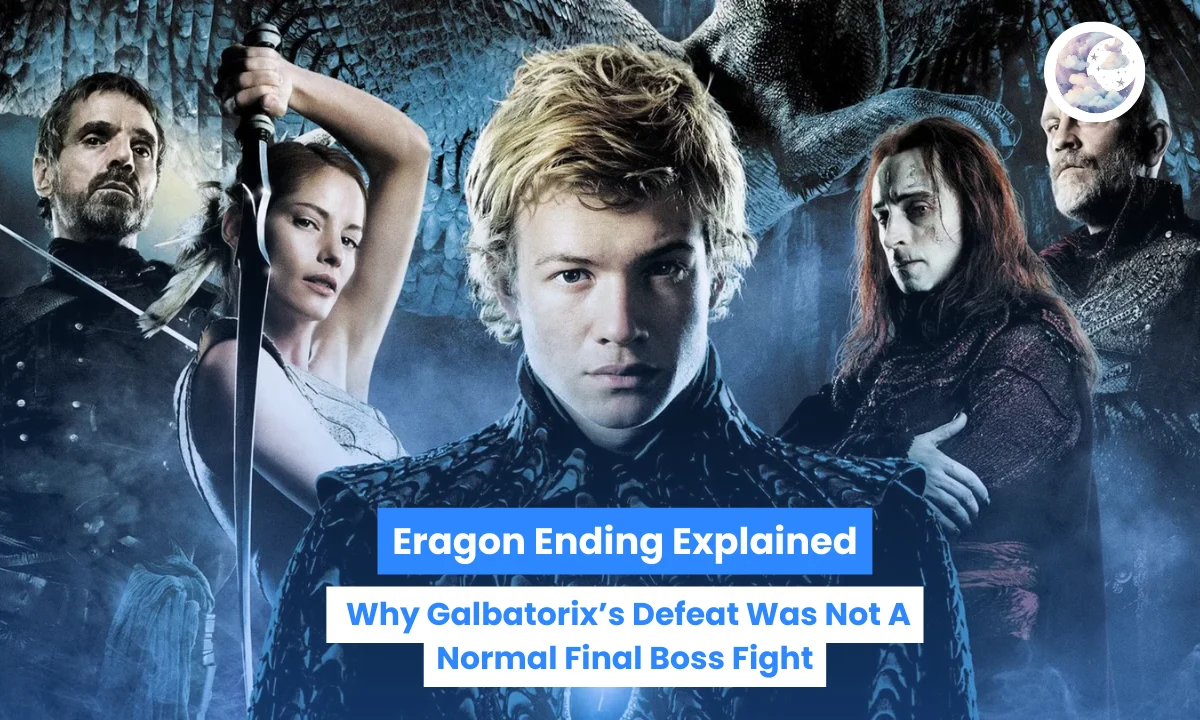
Eragon Ending Explained: Why Galbatorix’s Defeat Was Not A Normal Final Boss Fight
If you searched for Eragon ending explained, chances are you just finished Inheritance, the final book of the Inheritance Cycle, and you’re sitting there thinking, wait… that’s how Galbatorix dies? After four books of buildup, endless training, Dragon Riders, Eldunarí, ancient language magic, and rebellion, the final showdown in Alagaësia does not end with a flashy magical duel.
Instead, Christopher Paolini gives us something far more psychological and honestly, quite bold. The defeat of Galbatorix is not about brute strength. It is about empathy, guilt, and consequences. And that is exactly why fans are still debating it years later.
Before we break it down properly, let’s quickly cover the core points.
Key Takeaways
- Eragon does not overpower Galbatorix in a direct magical fight.
- Galbatorix is nearly invincible due to the true name of the ancient language and enslaved Eldunarí.
- Murtagh plays a crucial role by weakening Galbatorix’s wards.
- Eragon uses a non verbal empathy spell powered by the Eldunarí.
- Galbatorix is forced to experience the pain he caused across Alagaësia.
- Overwhelmed by guilt and agony, he casts a self destructive spell, “Be not.”
- The ending reflects themes of compassion, moral growth, and breaking cycles of hatred.
- Fans remain divided, with some praising the philosophical ending and others wanting a more epic battle.
Now let’s properly unpack everything.

The Setup For The Final Confrontation In Urû’baen
By the time we reach the climax of Inheritance, Eragon is no longer the farm boy from Carvahall. He is a fully trained Dragon Rider bonded with Saphira. He carries the wisdom and strength of multiple Eldunarí, which are the preserved hearts of dragons. These give him access to immense magical energy and knowledge.
The battle takes place in Urû’baen, the capital city ruled by Galbatorix. On paper, Eragon has grown powerful. In reality, Galbatorix is still leagues ahead.
Here is why:
| Advantage | Galbatorix | Eragon |
|---|---|---|
| Age & Experience | Centuries old | Young Rider |
| Eldunarí | Countless enslaved | Limited but willing |
| Magic Control | Knows true name of ancient language | Does not |
| Wards | Layered, nearly unbreakable | Strong but limited |
Galbatorix destroyed the original Dragon Riders. He enslaved dragons through mind control. He absorbed Eldunarí against their will. And most importantly, he discovered the true name of the ancient language. That knowledge gives him near god like control over magic.
A direct magical duel would have been suicide. Paolini makes this very clear.
Why A Traditional Final Battle Would Not Work
Many fantasy stories end with the hero unlocking hidden power and overpowering the villain. Think swords clashing, magical beams colliding, dramatic last second saves.
That does not happen here.
Galbatorix forces Eragon into mental combat. He manipulates. He mocks. He dominates. Even with Saphira and the Eldunarí supporting him, Eragon cannot simply break through the king’s defenses.
This is where Murtagh becomes important. Throughout the confrontation, Murtagh slowly strips away parts of Galbatorix’s protective wards. Without this, nothing else would have worked.
Still, even weakened, Galbatorix remains overwhelmingly powerful. So Eragon does something unexpected.

The Empathy Spell That Changes Everything
Instead of attacking Galbatorix physically, Eragon casts a spell without using the ancient language. That detail matters. Since Galbatorix controls the ancient language, a standard spell could be blocked.
Eragon creates something different. A raw expression of empathy amplified by the Eldunarí. The spell forces Galbatorix to fully experience every bit of pain he caused:
- The suffering of enslaved dragons
- The agony of murdered Dragon Riders
- The oppression of the people of Alagaësia
- The grief of families torn apart
- The destruction of entire communities
This is not an illusion. It is emotional and psychological reality forced into his mind. For someone who justified his tyranny for centuries, this is unbearable. Galbatorix always saw himself as right. As necessary. As superior.
Now he feels everything. And he breaks.
What Does “Be Not” Actually Mean
In desperation, Galbatorix begs Eragon to stop. Eragon refuses. Unable to endure the empathy, Galbatorix casts a final spell on himself. He says, “Be not.” In the ancient language, this is essentially a command for his own existence to cease.
The result is catastrophic. His body converts into pure energy in a massive explosion. It is described almost like a magical nuclear blast. The castle is devastated. The city is heavily damaged.
Eragon and the others barely survive because he shields them in time. So technically, Eragon does not kill Galbatorix directly. Galbatorix destroys himself to escape the guilt.
Meanwhile, Shruikan, the enslaved black dragon, is killed during the chaos. It is a tragic end for a creature forced into darkness.
Themes Behind The Ending
This ending is not random. It connects deeply to the themes of the Inheritance Cycle. The series constantly questions:
- What is right and wrong
- Whether violence solves anything
- How power should be used
- Whether cycles of hatred can be broken
Eragon’s growth is moral, not just magical. Roran might have tried brute force. Nasuada might have pursued strategy. Arya might have chosen direct combat.
Only Eragon thinks of forcing understanding. The message is simple but strong. True power is not domination. It is awareness and responsibility.
Paolini has explained that Galbatorix needed to remain stronger than Eragon. If Eragon simply overpowered him, the tension of the entire series would collapse. The win had to come from intelligence and character development.
Public Opinion On The Ending
This is where things get interesting.
Recent discussions on X show that fans are still debating the ending years later. The reactions usually fall into three camps.
1. The Supporters
These fans love the empathy based defeat. They argue it fits the story’s moral core. They say it is clever and refreshing compared to typical fantasy finales.
2. The Critics
Some readers feel underwhelmed. After four books of buildup, they expected an explosive magical duel. They think the final boss folded too easily once the spell hit.
3. The Mixed View
Others appreciate the anti violence message but wish there were higher personal stakes for Eragon. Some also connect their dissatisfaction to other elements, like Eragon leaving Alagaësia or the lack of romantic payoff with Arya.
There are even memes comparing this to modern storytelling tropes, joking about “defeating villains with therapy magic.” Some call it juvenile. Others defend it fiercely.
Love it or hate it, nobody forgets it.
Was It A Cop Out Or A Bold Move
The big question most people ask is simple. Did Galbatorix’s suicide feel earned? From a narrative standpoint, it makes sense:
- He was too powerful for direct defeat.
- His arrogance blinded him to emotional vulnerability.
- His entire rule was built on ignoring the suffering of others.
Being forced to confront that suffering is poetic justice.
But emotionally, some readers wanted spectacle. They wanted a cinematic clash. Something that felt visually massive.
Instead, Paolini chose philosophy over fireworks. And honestly, that is why the ending still sparks conversation today.
How This Impacts Eragon’s Future
After Galbatorix’s death, Eragon does not become king. He does not settle down. He leaves Alagaësia to rebuild the Dragon Riders elsewhere. This reinforces the idea that his journey is bigger than one victory. It is about creating a better future.
His departure also leaves fans divided. Some see it as mature and bittersweet. Others wanted a more satisfying closure.
Final Thoughts
The ending of Eragon is unconventional. It avoids the predictable power up moment. It refuses to reduce the conflict to simple good versus evil sword fighting.
Instead, it asks a heavier question. What if the worst punishment for a tyrant is understanding the pain they caused?
That choice makes the finale memorable. It also makes it controversial. If you expected a traditional fantasy climax, it may feel underwhelming. If you value thematic consistency and character growth, it feels earned.
Either way, Galbatorix’s defeat stands out in modern fantasy. It proves that sometimes the strongest move is not a stronger spell. It is forcing truth into the light.
Related Posts :



Share This Post