Lenskart Share Price: Q3 Profit Jump Sends Stock To Record High Above ₹530
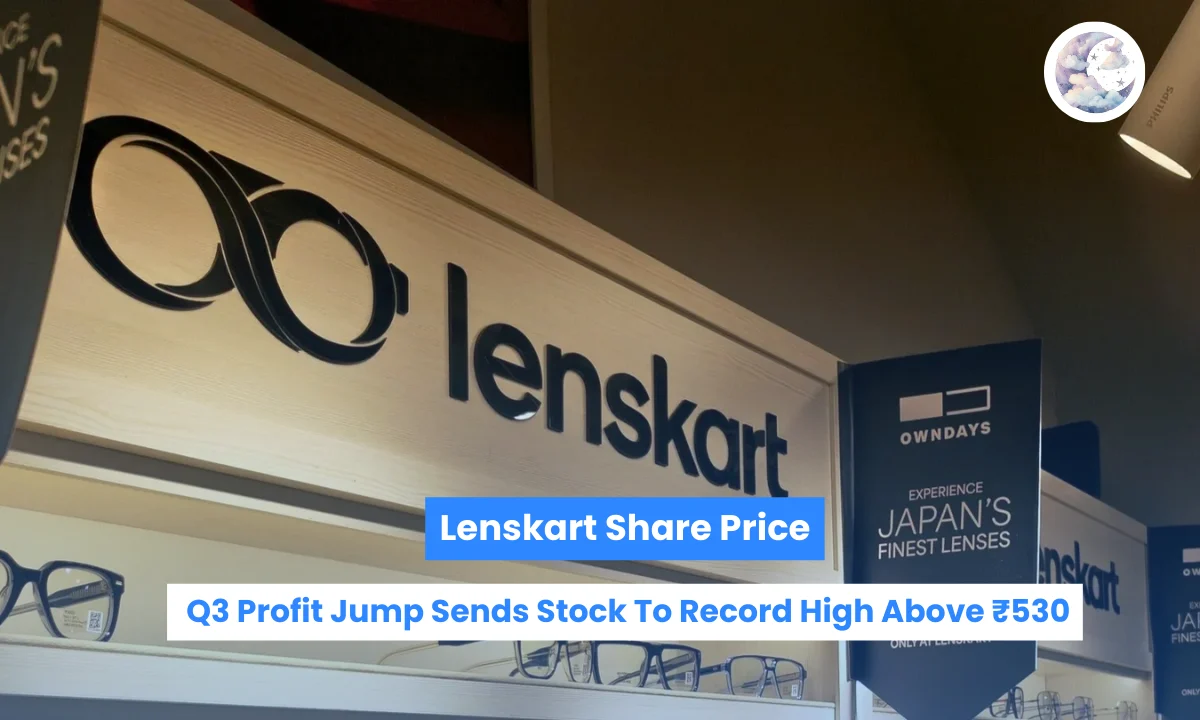
Lenskart share price has become one of the most searched stock queries after the company reported explosive Q3 FY26 results and surged to a new all time high above ₹530. As of February 13, 2026 morning trade, Lenskart Solutions Ltd is hovering in the ₹518 to ₹530 range, after closing near ₹513 in the previous session with a gain of about 9.71 percent. During intraday trade, the stock touched a fresh lifetime high around ₹533.
The company is now valued at roughly ₹89,000 to ₹90,000 crore in market capitalization. From its IPO price of ₹402, the stock has climbed nearly 28 to 30 percent. From the listing low of ₹356, the rally is even sharper at more than 45 percent. However, at a trailing P E multiple above 200 times earnings, the big question investors are asking is simple. Is this a structural long term compounder or a high growth stock that may cool off after the earnings excitement fades.
After a weak listing in November 2025, the stock has turned into one of the most talked about retail and D2C success stories in the public markets. Investors are now closely tracking earnings visibility, store expansion, international turnaround, and valuation comfort before making fresh allocation decisions.
Key Takeaways
- Lenskart share price recently touched an all time high near ₹532 to ₹533
- Q3 FY26 net profit jumped to about ₹132 to ₹133 crore from ₹1.8 crore last year
- Revenue grew 38 percent YoY to ₹2,308 crore
- EBITDA margin expanded to 20 percent
- 195 new stores added in one quarter
- Market cap stands near ₹90,000 crore
- Trailing P E is above 200 times, making valuation expensive
- Analyst targets range between ₹550 and ₹575
- Public sentiment remains largely positive after results

Lenskart Share Price Today And Live Snapshot
As of February 13, 2026, Lenskart share price is trading in the ₹518 to ₹530 band in early trade. The stock closed at around ₹513 in the previous session and rallied sharply following Q3 results announced after market hours on February 11.
Here is a quick snapshot of current market data:
| Metric | Data |
|---|---|
| Recent Closing Price | ₹513 |
| Intraday Range | ₹518 to ₹530 |
| Day High | ₹532 to ₹533 |
| 52 Week Low | ₹356.10 |
| 52 Week High | ₹533 |
| Market Capitalization | ₹89,000 to ₹90,000 crore |
| IPO Price | ₹402 |
| Listing Low | ₹356 |
The stock surged nearly 12 to 13 percent in the session following results, making it one of the top performing newly listed retail stocks in recent weeks. The strong move has attracted both institutional flows and retail interest.
IPO Recap And Listing Journey
Lenskart Solutions Ltd came to the market in November 2025 with an IPO price band of ₹382 to ₹402. The issue size was around ₹7,278 crore, comprising a fresh issue and an offer for sale. The IPO was subscribed more than 28 times, reflecting strong demand across institutional and retail categories.
However, listing day enthusiasm did not translate into immediate gains. The stock opened at a slight discount near ₹390 to ₹395 and later slipped to around ₹356 during early volatility. For a brief period, market participants questioned whether the valuation at IPO was aggressive.
From that listing low of ₹356, the stock has now rallied more than 45 percent, marking a strong comeback story within just three months of listing.
Funds raised from the fresh issue were earmarked for:
- Expansion of company owned stores
- Lease and rental payments
- Strategic initiatives and technology investments
- Strengthening supply chain and manufacturing capabilities
The company also implemented ESOP 2021 and ESOP 2025 schemes to align employee incentives with long term shareholder value creation.

Stock Performance Timeline Since IPO
To understand the rally, it helps to look at a structured timeline.
| Period | Price Level | Percentage Move |
|---|---|---|
| IPO Price (Nov 2025) | ₹402 | – |
| Listing Low | ₹356 | – |
| Feb 12 Close | ₹513 | +28% vs IPO |
| All Time High | ₹533 | +30% vs IPO |
The key trigger for the breakout above ₹500 was the Q3 FY26 earnings announcement. The stock moved sharply higher after markets digested the magnitude of profit growth and margin expansion.
Who Is Lenskart And Why The Story Matters
Lenskart was founded in 2010 by Peyush Bansal, along with Amit Chaudhary and Sumeet Kapahi. Peyush Bansal, a former Microsoft professional and widely known investor on the television show Shark Tank India, positioned Lenskart as a technology driven eyewear brand rather than just a retailer.
The company started as an online platform for contact lenses. Over the years, it evolved into a full stack omnichannel eyewear player with more than 2,000 stores globally, over 100 million app downloads, and manufacturing facilities in India and Thailand.
India’s eyewear market is estimated at around ₹79,000 crore currently. Industry estimates suggest that more than 500 million Indians require some form of vision correction. This implies a potential need based opportunity of nearly ₹4 lakh crore over time. Lenskart is not merely participating in this demand but actively creating it by conducting eye tests and expanding awareness.
In Q3 alone, the company conducted over 60 lakh eye tests, and nearly half of these were first time users. This indicates deep market penetration and long term structural growth potential.
What Triggered The Sharp Rally In Lenskart Shares
The rally was primarily driven by Q3 FY26 results for the October to December 2025 quarter. The numbers were significantly stronger than market expectations and demonstrated operating leverage benefits.
Q3 FY26 Financial Performance
Below is a detailed comparison of key metrics.
| Metric | Q3 FY26 | Q3 FY25 | YoY Change | QoQ Change |
|---|---|---|---|---|
| Revenue | ₹2,308 Cr | ₹1,669 Cr | +38% | +10% |
| EBITDA | ₹462 Cr | ₹243 Cr | +90% | +12% |
| EBITDA Margin | 20.0% | 14.5% | +550 bps | +31 bps |
| Net Profit | ₹133 Cr | ₹1.85 Cr | 70x | +29% |
| Stores Added | 195 | – | – | – |
The jump in net profit from less than ₹2 crore to over ₹130 crore marks a dramatic turnaround. The improvement was driven by higher revenue, better cost efficiencies, and improved margin profile.
India And International Performance
India revenue grew around 40 percent year on year with strong same store sales growth of about 28 percent. This indicates healthy demand even in mature locations.
International revenue grew about 33 percent. The overseas business, which had previously been loss making, turned profitable with positive EBITDA margin of around 6 percent in the nine month period. The company now operates roughly 705 stores internationally and holds a leadership position in Singapore.
This global turnaround story adds another growth lever beyond the domestic market.
Full Financial History And Long Term Trend
Short term earnings are impressive, but long term trends matter more. Here is a look at annual financial performance from FY23 onward.
| Year | Revenue (₹ Cr) | Growth | Net Profit (₹ Cr) | Key Note |
|---|---|---|---|---|
| FY23 | 3,788 | – | -64 | Loss making phase |
| FY24 | 5,428 | +43% | -10 | Near breakeven |
| FY25 | 6,653 | +23% | 297 | First full year profit |
| 9M FY26 | 6,298 | +29% | ~337 | Strong momentum |
Compounded sales growth over the past three years stands near 60 to 65 percent. This level of sustained expansion is rare in traditional retail.
Importantly, cash flow from operations in the nine month period of FY26 was robust, reportedly around ₹4,850 crore. This suggests that expansion is increasingly being funded internally rather than purely through external capital.
The transition from losses in FY23 to strong profitability in FY25 and FY26 shows clear operating leverage at scale.
Growth Engine And Future Outlook
The investment thesis for Lenskart revolves around multiple growth engines operating simultaneously.
Store Expansion Strategy
The company added 420 net stores in the first nine months of FY26. Management guidance indicates 450 plus net additions for the full year. Many of these stores are being opened in tier 2 and tier 3 cities where eyewear penetration remains low.
New stores in smaller cities are reportedly generating average monthly revenue of around ₹1.32 lakh, reflecting strong local demand.
Technology And Innovation
Lenskart differentiates itself through technology integration. AI powered eye testing, remote optometry across 369 stores, and digital prescription management strengthen its value proposition.
The company is also soft launching smart glasses under the B by Lenskart brand in Q4. While currently a small revenue contributor, such innovation reinforces brand positioning as a tech forward eyewear company rather than a basic retailer.
International Scaling
International operations now include over 700 stores. Singapore is already a leading market, and management believes international markets today resemble India’s growth phase from several years ago. If executed well, overseas operations can double revenue contribution over time.
Brokerage View And Target Price
Brokerage houses have responded positively to Q3 results.
Jefferies reportedly has a Buy rating with a target near ₹575. JM Financial’s target stands around ₹565. Emkay Global suggests around ₹550, while Antique has a more cautious view near ₹503 with a Hold recommendation.
The consensus implies about 10 to 15 percent upside from current levels, assuming earnings trajectory remains intact.
Analysts have praised margin expansion and disciplined capital allocation but continue to highlight valuation risk.
Valuation Reality Check And Peer Comparison
At current levels, Lenskart trades at a trailing P E above 200 times and around 14 times book value. On a price to sales basis, it trades near 8 times revenue.
Compared to eyewear peers within larger conglomerates, Lenskart commands a premium because eyewear is its core focus and growth driver. Investors are effectively paying today for expected 30 percent plus revenue CAGR and further margin expansion over the next two to three years.
The bull case assumes that if revenue continues compounding at 30 percent and margins expand steadily, earnings could grow rapidly, compressing the P E multiple to more reasonable levels over time.
The bear case warns that if growth slows even modestly, valuation multiples could derate sharply as seen in several other high growth IPO names.
Risks Investors Should Consider
No investment is without risk, especially at elevated valuations.
- High P E multiple leaves little margin for error
- Possible block deal activity from private equity investors
- Forex exposure due to imported frames and components
- Competitive pressure from unorganized and branded players
- No dividend payout as profits are reinvested
- Execution risk in international markets
Investors should monitor quarterly same store sales growth, margin trends, and debt levels closely.
Technical View And Market Sentiment
From a technical perspective, immediate support lies in the ₹480 to ₹500 zone. Resistance may emerge around ₹550 to ₹575, which aligns with brokerage target ranges.
On social media platforms such as X, sentiment has largely been positive post results. Many users describe Lenskart as a rare profitable D2C success story. At the same time, some caution that the stock appears expensive and could see volatility if broader markets correct.
Overall tone remains optimistic but aware of valuation concerns.
Should You Invest In Lenskart Now
For long term investors with a three to five year horizon, Lenskart offers exposure to a fast growing, organized eyewear market with strong brand recall and integrated manufacturing. If revenue growth sustains above 30 percent and margins improve further, earnings compounding could justify current valuation over time.
For short term traders or valuation conscious investors, waiting for a 10 to 15 percent correction may provide better risk reward. High multiple stocks often experience sharp swings during market volatility.
The decision ultimately depends on risk appetite, portfolio allocation strategy, and conviction in the company’s ability to execute.
Frequently Asked Questions
What is Lenskart share price today
As of February 13, 2026, Lenskart share price is trading around ₹518 to ₹530, with a recent close near ₹513.
What is the target price for 2026
Brokerage targets currently range between ₹550 and ₹575 based on earnings growth assumptions.
Is demat account required to buy Lenskart shares
Yes, investors need a demat and trading account to buy shares listed on Indian exchanges such as NSE or BSE.
Is Lenskart profitable
Yes, the company reported ₹297 crore net profit in FY25 and continues to report strong profitability in FY26.
Final Thoughts On Lenskart Share Price
Lenskart share price has delivered a powerful comeback from its post listing lows. The Q3 FY26 results confirmed that the company is entering a strong profitability phase supported by revenue growth, margin expansion, and aggressive store addition.
However, valuation remains demanding. Sustained earnings growth is essential to justify current multiples. Investors who believe in the structural eyewear opportunity and the company’s execution capabilities may view this as a long term compounding story. Those focused on valuation discipline may prefer staggered entry on corrections.
For real time updates, investors should check official exchange platforms such as NSE India or BSE during market hours, as prices fluctuate continuously.
Tags: lenskart share price, Lenskart Q3 FY26 results, Lenskart IPO, Lenskart stock analysis, Peyush Bansal, retail stocks India, NSE listed companies, eyewear market India
Related Posts :




Share This Post