Why Waaree Energies Share Is Falling: Complete Analysis of the Stock Decline and Future Outlook
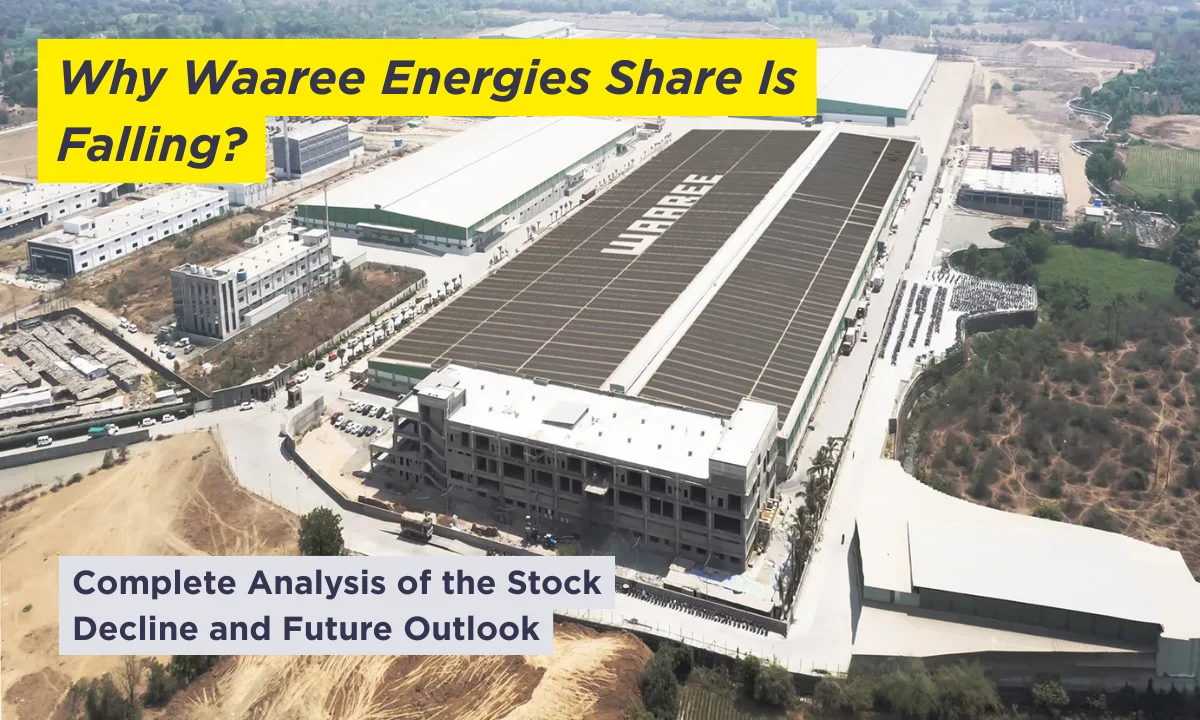
Why Waaree Energies Share Is Falling: Complete Analysis of the Stock Decline and Future Outlook
Waaree Energies has become one of the most talked about stocks in the Indian renewable energy sector. The company has shown remarkable growth over the past few years, yet its share price has experienced significant volatility in early 2026. Investors are asking important questions.
Why is Waaree Energies share falling? Is it good to hold Waaree Energy share? What is the future of Waaree?
This comprehensive blog post gives answers of all these questions with factual data and clear insights. The stock has fallen from its 52 week high of ₹3,865 to trading levels around ₹3,065 to ₹3,220 in early April 2026 .
This represents a significant correction that has left many investors confused. The company continues to report strong financial results with record breaking quarterly performance, yet the market sentiment has turned cautious. Understanding the reasons behind this disconnect between fundamentals and stock price movement is essential for making informed investment decisions.
In this article examines the four major reasons why Waaree Energies share is falling. It analyzes the impact of US tariffs on Indian solar imports, the company’s high export exposure, recent leadership changes, and broader market factors. The article also explores whether holding Waaree Energies shares makes sense for different types of investors and what the future holds for this solar energy giant.
Table of Contents
The Primary Trigger: US Tariffs on Indian Solar Imports
The 126% Duty Announcement
The most significant reason for the sharp fall in Waaree Energies share price occurred on February 25, 2026. On this day, the US Commerce Department announced preliminary countervailing duties of approximately 126% on solar cells and modules imported from India . This announcement created immediate panic in the market and triggered a massive sell off across the entire Indian solar sector.
Waaree Energies shares plunged as much as 14% to 15% intraday on February 25, 2026, hitting lows around ₹2,570 to ₹2,580 . The stock hit lower circuit limits during the trading session. Other solar companies also faced selling pressure, with Premier Energies falling over 12% and Vikram Solar declining nearly 7% . However, Waaree experienced the sharpest decline among its peers due to its specific business exposure.
The US Commerce Department imposed these duties following a petition filed by the Alliance for American Solar Manufacturing and Trade, which includes major American solar manufacturers like Hanwha Qcells, First Solar, and Mission Solar . The petition alleged that Indian solar manufacturers received unfair government subsidies that made American products less competitive in the domestic market.
Understanding the Tariff Structure
The preliminary countervailing duty rate of 125.87% applies specifically to solar cells and modules manufactured in India using Indian made solar cells . This distinction is important because the tariff does not apply to solar panels that are merely assembled in India using cells imported from other countries. This means approximately 4% of total US solar imports from India face the full impact of these duties immediately .
The US Commerce Department is expected to issue a final determination on these duties by July 2026 . Additionally, another ruling is expected in the coming months to determine whether exporters from India sold products in the US at prices below their production costs. If this anti dumping investigation finds evidence of dumping, additional duties may be imposed on top of the existing countervailing duties .
Historical Context of US India Solar Trade
The timing of this tariff announcement is particularly significant because US solar imports from India have grown dramatically in recent years. According to US Commerce Department data, solar imports from India were valued at $192.6 million in 2024, representing a more than nine fold increase compared to 2022 levels . India, Indonesia, and Laos together accounted for 57% of all US solar module imports in the first half of 2025 .
This rapid growth in exports made Indian manufacturers increasingly dependent on the US market. The sudden imposition of 126% duties threatens to reverse this trade relationship and force Indian companies to find alternative markets or reconfigure their supply chains completely.
Export Exposure: Why Waaree Is More Vulnerable Than Competitors
Revenue Breakdown by Geography
Waaree Energies faces higher risk from US tariffs compared to its domestic competitors because of its significant export dependence. In Q3 FY26, approximately 32.6% of Waaree’s revenue came from overseas markets, with the US serving as the primary destination . This high export exposure makes Waaree the most vulnerable among major Indian solar manufacturers to US trade restrictions.
The following table compares the export exposure of major Indian solar companies:
| Company Name | Export Revenue Exposure | Primary Risk Level | Key Markets |
|---|---|---|---|
| Waaree Energies | 32.6% of Q3 FY26 revenue | High | US accounts for majority of exports |
| Vikram Solar | 20% of order book | Moderate | Multiple international markets |
| Premier Energies | Less than 1% of Q3 revenue | Low | Primarily domestic focused |
This comparison clearly shows why Waaree Energies experienced a sharper stock price decline than its peers. While Premier Energies remains largely insulated from US tariff impacts due to its domestic focus, and Vikram Solar faces moderate exposure, Waaree’s substantial US revenue dependence creates significant earnings risk .
US Manufacturing Capacity as a Partial Hedge
Waaree Energies has been proactively building US manufacturing capacity to mitigate tariff risks. The company currently operates 22.8 GW of module manufacturing capacity in India and 1.6 GW in the US . The US facility allows Waaree to supply part of American demand through local production rather than exports from India.
Waaree has announced plans to expand its US manufacturing capacity significantly. The company is doubling capacity at its Houston, Texas plant from 1.6 GW to 3.2 GW . Additionally, Waaree acquired a 1 GW module manufacturing line from Swiss firm Meyer Burger in Arizona . The company has invested approximately $150 million in the US so far and plans to expand this investment eight fold by potentially adding cell manufacturing and battery storage systems .
However, this US capacity provides only partial protection. Since the bulk of Waaree’s manufacturing scale sits in India, the US facilities can only offset a portion of any disruption caused by tariffs on Indian exports. The company has stated that it does not anticipate any material adverse impact on its ability to service the US order book, and expects its US manufacturing capacity to substantially support existing US commitments .
Supply Chain Reconfiguration Strategy
Waaree Energies is actively reconfiguring its supply chain to bypass the impact of US tariffs. The company is sourcing solar cells from nations that have low tariffs on their exports to the US . This strategy relies on a 2012 US customs ruling that attributes a solar panel’s country of origin to the country where its cells were manufactured.
By sourcing cells from countries with favorable tariff treatment, Waaree can assemble panels in India and export them to the US without facing the full 126% duty on Indian made cells. However, this strategy adds complexity to the supply chain and may impact margins due to potentially higher cell costs from alternative sources.
Leadership Changes & Management Transition
CEO and CFO Resignations
Another factor contributing to stock price volatility in March 2026 was significant leadership changes at Waaree Energies. On March 20, 2026, the company announced that CEO Amit Ashok Paithankar had resigned from his position earlier than the previously planned date of May 15, 2026 . The resignation was mutually agreed between the company and Paithankar.
Simultaneously, CFO Sonal Shrivastava also stepped down on March 20, 2026, following the completion of her notice period . These dual departures at the highest executive levels created short term uncertainty in the market and contributed to selling pressure on the stock.
New Leadership Appointments
Waaree Energies moved quickly to fill these positions with internal candidates who have long tenures with the company. The board appointed Jignesh Devchandbhai Rathod as the new Whole Time Director and CEO, effective March 21, 2026 . Rathod has been associated with Waaree since November 2007, giving him nearly 19 years of experience within the organization. He will serve a five year term until March 20, 2031.
For the CFO position, the company appointed Abhishek Pareek, who has been with Waaree since September 2017 and previously served as Group Finance Head . Both appointments represent continuity rather than dramatic strategic shifts, as both executives have deep institutional knowledge of Waaree’s operations and culture.
Market Reaction to Management Changes
Markets typically react negatively to unexpected leadership changes, even when the transitions appear orderly. Investors worry about potential strategy shifts, execution risks during the transition period, and whether new leadership can maintain the growth trajectory established by their predecessors.
In Waaree’s case, the early departure of the CEO created additional uncertainty because it suggested either disagreements about strategic direction or concerns about the company’s ability to navigate the challenging US tariff environment. While the company presented the changes as part of planned succession for the next growth phase, the timing so close to the tariff announcement amplified investor concerns .
Market and Technical Factors Contributing to the Decline
Profit Booking After Strong Rally
Waaree Energies shares had experienced a significant rally prior to the February 2026 tariff announcement. The stock reached an all time high of ₹3,865 in late 2025, representing substantial gains from its IPO price . After such strong performance, profit booking by investors was natural and expected.
The inclusion of Waaree Energies in the F&O (Futures and Options) segment increased volatility as traders took positions based on short term price movements. Short selling by traders betting on further declines and technical selling triggered by bearish signals added to the downward pressure .
Technical Analysis Signals
Technical indicators showed weakness in Waaree’s stock price even before the tariff announcement. The stock began trading below key moving averages, and MACD (Moving Average Convergence Divergence) indicators showed bearish signals . These technical factors led to sustained selling pressure in early 2026 as algorithmic traders and technical analysts reacted to the chart patterns.
The stock’s beta value indicates higher volatility compared to the broader market, meaning Waaree shares tend to move more dramatically than the overall market in both directions . This inherent volatility amplifies both gains and losses, making the stock suitable primarily for investors with higher risk tolerance.
Broader Sector Weakness
The entire solar sector has faced headwinds beyond just the US tariff issue. Global solar oversupply has put pressure on pricing across the industry. Chinese manufacturers continue to dominate global production, creating intense competition for Indian companies .
Input cost pressures from raw material price fluctuations and supply chain disruptions have also affected margins across the sector. Earlier investigations by US authorities into duty evasion allegations had already created periodic volatility in Indian solar stocks throughout 2025 .
Strong Fundamentals That Support Long Term Value
Record Breaking Financial Performance
Despite the stock price decline, Waaree Energies’ underlying business fundamentals remain exceptionally strong. The company delivered record breaking results in Q3 FY26, with revenue jumping 118.8% year over year to ₹7,565 crore . EBITDA surged 167% to ₹1,928 crore, with margins expanding to 25.5% from 20.9% in the prior year period .
Profit after tax rose 118% year over year, demonstrating the company’s ability to convert revenue growth into bottom line profits . For the nine months of FY26, the company has achieved significant growth in both topline and EBITDA, reflecting the resilience of its business model .
Massive Order Book Provides Visibility
Waaree Energies reported a record order book of approximately ₹60,000 crore as of Q3 FY26 . This massive backlog provides revenue visibility for 2 to 3 years and demonstrates strong demand for the company’s products and services.
The company’s order inflow has been particularly strong in the module segment, where Waaree became the first Indian manufacturer to achieve 1 GW plus of module production and sales in a single month . The company produces 52 modules per minute at peak capacity, showcasing operational efficiency and scale advantages.
Production Capacity and Expansion
Waaree continues to expand its manufacturing capabilities aggressively. In Q3 FY26, the company commissioned several new facilities including a 2.1 GW module plant at Chikhli, Gujarat, a 3 GW module facility at Samakhiali, Gujarat, and a 3.05 GW inverter capacity at Sarodhi, Gujarat .
The company achieved 3.51 GW of solar module production and 0.75 GW of solar cell production in Q3 FY26 . Waaree is also expanding into adjacent areas including battery energy storage systems (BESS), electrolysers for green hydrogen production, and wind energy projects .
Vertical Integration Strategy
Waaree Energies is pursuing aggressive vertical integration to reduce dependence on Chinese imports and improve margins. The company recently announced ₹3,900 crore capital expenditure for a solar glass plant, representing backward integration into a critical component .
The company has also increased its stake in power transmission assets and won a wind project in Gujarat, signaling evolution into a full stack renewable energy player rather than just a solar module manufacturer . This diversification reduces reliance on any single product category or geography.
Is It Good to Hold Waaree Energy Share?
Analyst Consensus and Price Targets
Despite the recent decline, analyst sentiment toward Waaree Energies remains predominantly positive. Of the 15 analysts covering the stock, 11 maintain buy ratings while only 4 recommend sell . This represents 73% bullish coverage, indicating that professional analysts see value in the stock at current levels.
The average analyst price target for Waaree Energies is approximately ₹4,130, representing potential upside of over 34% from current trading levels around ₹3,070 . Individual brokerage targets vary, with Nomura maintaining a buy rating and price target of ₹2,709, Motilal Oswal setting a target of ₹3,514, and Nuvama maintaining a buy with target of ₹3,867 .
Arguments for Holding the Stock
Investors with a long term horizon have several reasons to consider holding or accumulating Waaree Energies shares during the current weakness:
Strong Domestic Market Growth: India’s solar capacity stands at over 135 GW as of December 2025, with the government targeting 500 GW of non fossil fuel capacity by 2030 . This massive expansion creates sustained demand for domestic solar manufacturers.
Market Leadership Position: Waaree captured 17.3% of total module shipments in Q1 2025, making it India’s largest solar module supplier . This leadership position provides scale advantages and pricing power.
Diversification Beyond Solar: The company’s expansion into wind energy, battery storage, green hydrogen electrolysers, and power transmission creates multiple growth avenues .
US Manufacturing Presence: Unlike pure export dependent competitors, Waaree’s US manufacturing facilities provide a hedge against trade restrictions and access to the world’s second largest solar market .
Strong Balance Sheet: The company has demonstrated ability to fund expansion through internal accruals and has maintained reasonable debt levels relative to its growth rate .
Risks to Consider
Investors should also weigh the following risks before deciding to hold Waaree shares:
Trade Policy Uncertainty: The final determination on US tariffs is pending until July 2026, and additional anti dumping duties could be imposed . Prolonged trade tensions could significantly impact export revenues.
Execution Risk: The company has announced massive capital expenditure plans including solar glass manufacturing, cell capacity expansion, and US facility expansion. Any delays or cost overruns could impact financial performance.
Competition: Chinese manufacturers continue to dominate global solar production with significant cost advantages. Indian manufacturers face ongoing pressure to remain competitive on price while maintaining quality.
Valuation Concerns: Despite the recent correction, Waaree trades at a price to earnings ratio of approximately 27 times trailing twelve months earnings . While this is below the sector average of 68 times, it still represents a premium valuation that assumes continued high growth.
Investor Profile Suitability
Waaree Energies shares are most suitable for investors with the following characteristics:
- Long term investment horizon of at least 3 to 5 years
- High risk tolerance given the stock’s volatility
- Belief in India’s renewable energy growth story
- Comfort with global trade policy uncertainty
- Ability to withstand short term price fluctuations
Investors seeking stable income or those with low risk tolerance may find Waaree’s volatility uncomfortable. The stock is more appropriate for growth oriented portfolios rather than conservative income focused strategies.
What Is the Future of Waaree?
Growth Projections and Forecasts
Analysts forecast that Waaree Energies will grow earnings at approximately 15.9% per annum and revenue at 18.6% per annum over the coming years . Return on equity is expected to remain strong at approximately 23.9% over the next three years .
Nuvama Institutional Equities estimates that Waaree’s revenue will cross ₹25,000 crore in FY27, with FY24 to FY27 revenue growing at a 30% compound annual growth rate and EBITDA growing at 54% CAGR . This growth is expected to be driven by the company’s sizeable order book and capacity expansion.
Strategic Vision and Expansion Plans
Waaree Energies is positioning itself as a comprehensive energy transition company rather than just a solar module manufacturer. The company’s strategic initiatives include:
Backward Integration: Building solar glass manufacturing capacity to reduce dependence on external suppliers and capture more value from the supply chain .
US Market Expansion: Doubling US manufacturing capacity to 3.2 GW and potentially adding cell manufacturing capabilities to serve the American market from domestic production .
New Technology Areas: Entering battery energy storage systems, green hydrogen electrolysers, and wind energy to diversify revenue streams .
Global Footprint: Launching an Australian subsidiary in December 2024 to tap into the Asia Pacific renewable energy market .
Industry Tailwinds
Multiple macro trends support Waaree’s long term growth prospects:
Government Policy Support: India’s basic customs duty on imported modules, the Approved List of Models and Manufacturers (ALMM), and mandatory domestic content requirements for government schemes create a protected market for domestic manufacturers .
Renewable Energy Transition: Global shift toward clean energy creates sustained demand for solar products. India aims to add 50 GW of renewable capacity annually over the next 5 to 6 years .
Supply Chain Diversification: Global efforts to reduce dependence on Chinese solar manufacturing create opportunities for Indian manufacturers with credible scale and quality.
Corporate Renewable Procurement: Increasing corporate demand for renewable energy to meet sustainability goals drives demand for solar installations globally.
Potential Catalysts for Stock Recovery
Several developments could trigger a recovery in Waaree’s share price:
- Favorable resolution of US tariff investigations with lower than expected final duty rates
- Strong Q4 FY26 results demonstrating continued growth momentum
- Successful commissioning of new manufacturing facilities on schedule
- Major new order wins from domestic or international customers
- Positive developments in the US Customs and Border Protection investigation
- Clarity on the new CEO’s strategic priorities and execution capabilities
My Final Words On Waaree Energies Share Price Fall
Waaree Energies share price has fallen due to a combination of external shocks and internal transitions. The 126% US tariff announcement in February 2026 served as the primary catalyst for the sharp decline, amplified by the company’s high export exposure. Leadership changes in March 2026 added short term uncertainty, while technical selling and profit booking exacerbated the downward pressure.
However, the company’s fundamental business remains exceptionally strong. Record revenue growth, expanding margins, a massive ₹60,000 crore order book, and strategic expansion into adjacent energy transition areas provide a solid foundation for future growth. The company’s proactive approach to building US manufacturing capacity and reconfiguring supply chains demonstrates management’s ability to adapt to changing trade conditions.
For investors asking whether to hold Waaree Energy shares, the answer depends on individual risk tolerance and investment horizon. Long term investors who believe in India’s renewable energy growth story and can withstand volatility may find the current weakness presents an opportunity to accumulate shares at discounted valuations. The analyst consensus remains bullish with an average price target suggesting significant upside potential.
The future of Waaree Energies appears promising despite near term headwinds. The company is evolving from a solar module manufacturer into a comprehensive energy transition solutions provider. With India’s ambitious renewable energy targets, supportive government policies, and global supply chain diversification trends, Waaree is well positioned to capture a significant share of the growing clean energy market.
Investors should monitor upcoming developments including the final US tariff determination in July 2026, Q4 FY26 results, and execution on announced capacity expansions. While short term volatility is likely to continue, the long term growth story for Waaree Energies remains intact for investors with appropriate risk appetite and patience.
Related Posts :




Share This Post