Why IT Stocks Are Falling Today: TCS, Infosys, Wipro Share Price Crash and Nifty IT Slump Explained
Why IT Stocks Are Falling Today: TCS, Infosys, Wipro Share Price Crash and Nifty IT Slump Explained
The Indian IT sector is facing one of its most intense sell-offs in recent years, and the discussion around TCS share, Infosys share, Wipro share, and overall IT stocks falling has taken center stage in February 2026. Investors, traders, and even employees are closely tracking movements in the TCS share price, Infosys share price, Wipro share price, Coforge share price, and Tech Mahindra share price as the broader Nifty IT index continues to slide.
This is not just a one-day correction. The pressure on IT stocks has been building steadily, and the recent sharp fall has triggered serious questions. Why are IT stocks falling today? Is this a temporary dip or a structural shift driven by artificial intelligence? Should investors hold, sell, or accumulate at lower levels? In this detailed analysis, we break down every major factor affecting IT stocks right now and provide a complete picture that competitors are missing.
TCS Share Price: What Is Happening?
Tata Consultancy Services has seen a sharp correction in recent sessions. The TCS share price has traded in the range of approximately ₹2,585 to ₹2,679 intraday, marking a fresh 52-week low near ₹2,585. This represents a fall of roughly 2.9 percent to 5.5 percent from earlier closing levels near ₹2,750.
More importantly, this is not just a single-session decline. TCS has been in a multi-day losing streak and has shed more than 12 percent cumulatively in recent sessions. Over the past several months, the stock has corrected nearly 25 to 30 percent from its highs, depending on the time frame considered.
A significant milestone was also breached recently when TCS market capitalization slipped below ₹10 lakh crore for the first time since 2020. This has psychological importance for investors because TCS has long been considered one of the strongest and most stable blue-chip stocks in India.
Despite the fall, some core fundamentals remain relatively solid. TCS continues to maintain a dividend yield in the range of 2.2 percent to 3.9 percent. Historically, the company has delivered strong return on equity and return on capital employed. It is also actively investing in AI-led services, with annualized AI revenue reportedly around 1.8 billion dollars and growing quarter on quarter. However, the market is currently focused more on near-term risks than long-term strengths.
Nifty IT: The Sector Under Pressure
Nifty IT has slumped sharply and is now among the worst-performing sectoral indices in 2026 so far. The index has fallen roughly 15.5 percent in February 2026 alone, marking one of its worst starts to a year since the global financial crisis era.
The fall is broad-based. It is not just TCS. The entire IT pack including Infosys, Wipro, HCLTech, Tech Mahindra and Coforge has witnessed sharp selling.
Some stocks have fallen as much as 5 to 6 percent in a single trading session. The correction has erased significant market capitalization across the sector and has also impacted overall benchmark indices due to the heavy weight of IT stocks in major indices.
When Nifty IT falls sharply, it tends to drag the entire market lower because IT companies contribute a large share to India Inc profit pool and foreign institutional investor allocations.
Infosys Share Price and Infosys Share Performance
The Infosys share price has mirrored the broader weakness in the sector. Infosys shares have declined significantly in recent sessions, reflecting concerns around revenue growth, margin compression, and future deal pipelines.
Infosys has also faced selling pressure in overseas markets. Its American Depositary Receipts have seen sharp declines, adding to the negative sentiment domestically. Over the past year, Infosys share has underperformed compared to historical averages, raising questions about growth sustainability in a changing global environment.
Although Infosys remains financially strong with a healthy balance sheet and strong client base, the market is re-evaluating growth multiples due to slower discretionary spending by global clients and increasing automation through artificial intelligence tools.
Wipro Share Price and Wipro Share Trends
Wipro share price has also experienced a meaningful correction. The stock has been underperforming relative to peers in recent quarters and is now trading near multi-month lows.
Wipro share faces the dual challenge of slower revenue growth and margin pressure. In addition, investors are questioning whether traditional outsourcing models can maintain pricing power in an AI-driven world where automation can replace repetitive services.
Even though Wipro continues to invest in cloud and AI capabilities, the transition phase is creating uncertainty. The stock is currently trading below important technical levels, indicating bearish momentum in the short term.
Coforge Share Price and Mid-Cap IT Stocks
Coforge share price has been among the worst hit within the mid-cap IT space during this correction. Mid-sized IT companies are often more sensitive to global deal flows and sector-specific sentiment.
When fear rises in the IT sector, investors tend to exit mid-cap stocks first due to perceived higher risk. Coforge has strong capabilities in certain verticals, but the overall sector pressure and AI disruption narrative have weighed heavily on sentiment.
Tech Mahindra Share Price
Tech Mahindra share price has also corrected sharply amid sector-wide selling. The company is navigating its own transformation and restructuring initiatives, but broader macro and AI-related fears have overshadowed company-specific improvements.
Tech Mahindra, like its peers, is attempting to reposition itself in digital transformation and AI services. However, the market is currently pricing in slower near-term growth rather than potential long-term gains.
Why IT Stocks Are Falling Today: Key Reasons
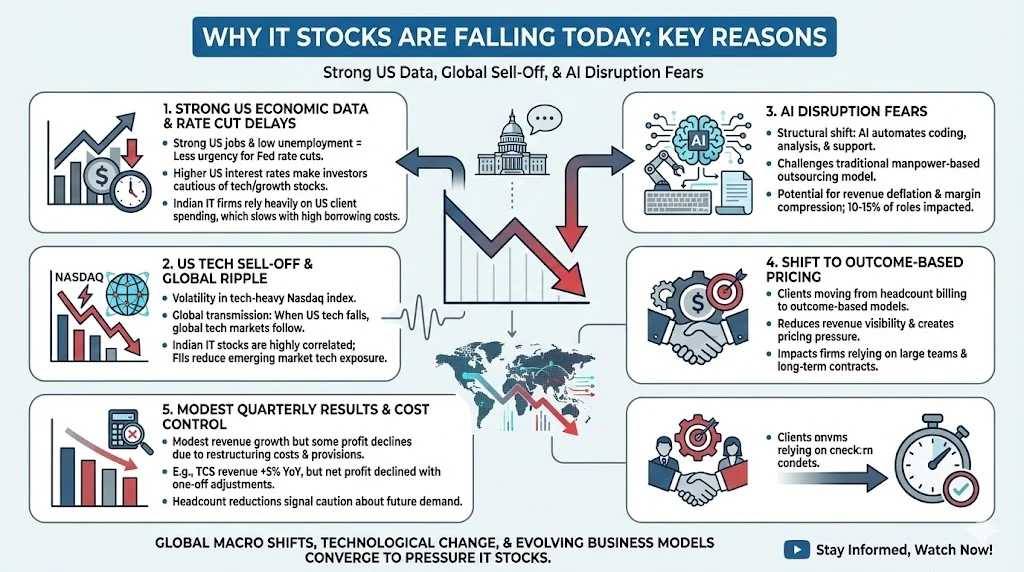
Now let us answer the central question directly. Why are IT stocks falling today and why has the decline been so severe?
1. Strong US Economic Data and Delayed Rate Cuts
One of the biggest triggers has been stronger-than-expected US employment data. When US jobs numbers come in strong and unemployment remains stable or declines, it reduces the urgency for the US Federal Reserve to cut interest rates.
Higher interest rates in the United States make investors cautious toward growth and technology stocks. Indian IT companies earn a large portion of their revenue from US clients. If borrowing costs remain high and financial conditions stay tight, corporate tech spending may slow down.
This macro linkage is crucial. A large share of revenue for companies like TCS, Infosys, and Wipro comes from North America. If US companies reduce discretionary IT spending, Indian IT revenue growth slows.
2. US Tech Sell-Off and Global Transmission
The technology-heavy Nasdaq index has witnessed volatility and declines recently. When US technology stocks fall, it often creates a ripple effect across global technology markets.
Indian IT stocks are highly correlated with US tech sentiment because their clients are global technology and enterprise firms. If Wall Street weakens, foreign institutional investors often reduce exposure to emerging market tech stocks as well.
This global transmission effect is amplifying the correction in Indian IT shares.
3. AI Disruption Fears
The most important structural reason behind the fall in IT stocks is fear of artificial intelligence disruption.
New AI tools are capable of automating tasks in coding, legal documentation, sales support, and data analysis. This directly challenges the traditional manpower-based outsourcing model that Indian IT companies have relied on for decades.
If AI can complete projects faster and cheaper, companies may require fewer billable hours and smaller teams. This could lead to revenue deflation and margin compression in traditional service lines.
There are even projections suggesting that 10 to 15 percent of IT services roles could be impacted over the next few years if automation accelerates significantly.
4. Shift to Outcome-Based Pricing
Clients are increasingly shifting from headcount-based billing to outcome-based pricing models. Instead of paying for the number of employees deployed, clients want measurable business results.
This transition can reduce revenue visibility and create pricing pressure for IT companies that historically relied on large teams and long-term contracts.
5. Modest Quarterly Results
Recent quarterly results for major IT firms showed modest revenue growth but some profit declines due to restructuring costs and one-time provisions.
For example, TCS reported revenue growth of around 5 percent year-on-year in the latest quarter, but net profit declined due to one-off adjustments and restructuring-related provisions.
Headcount reductions have also been reported across the sector. Cost control measures signal caution about future demand conditions.
Public Sentiment and Investor Psychology (Data From X)
Public sentiment on social media platforms has been largely cautious to bearish. Many investors are debating whether this correction represents a structural shift rather than a temporary dip.
There are concerns about layoffs, shrinking entry-level opportunities, and AI replacing routine roles. At the same time, some long-term investors view the correction as a buying opportunity at attractive valuations.
The debate is intense. On one side are those who believe AI will permanently reduce IT services revenue. On the other side are optimists who argue that the IT sector has successfully navigated transitions before, including Y2K, cloud computing, and digital transformation waves.
Is This the End of Indian IT Growth?
History suggests that Indian IT companies are highly adaptive. They have reinvented themselves multiple times over the past three decades.
The current challenge is different because AI is not just another service line. It has the potential to fundamentally change delivery models. However, it also creates new opportunities.
Companies that build proprietary AI tools, invest in intellectual property, and move up the value chain into consulting and platform ownership may emerge stronger.
The key differentiator will be speed of adaptation. Firms that successfully integrate AI into service offerings rather than resist it are likely to survive and grow.
Technical Outlook for IT Stocks
From a technical analysis perspective, Nifty IT has broken below important support levels and is trading below key moving averages.
Heavy trading volumes on down days indicate strong selling pressure. Relative strength indicators for many IT stocks are in oversold territory, suggesting the possibility of a short-term bounce.
However, the broader trend remains weak until clear signs of recovery in global tech sentiment and deal pipelines emerge.
What Should Investors Do Now?
Investors should avoid panic-driven decisions. Volatility often creates both risk and opportunity.
Long-term investors with strong conviction in the Indian IT sector may consider staggered accumulation in fundamentally strong companies. Dividend yield support and strong balance sheets offer some cushion.
Short-term traders should remain cautious because volatility can continue until clarity emerges regarding US rate cuts, global tech stability, and AI-driven revenue models.
It is essential to monitor quarterly deal wins, AI service revenue growth, and commentary from management about client spending patterns.
Conclusion: A Structural Reset or Temporary Correction?
The fall in TCS share price, Infosys share price, Wipro share price, Coforge share price, and Tech Mahindra share price is driven by a combination of macroeconomic triggers and structural AI-related fears.
Nifty IT is currently the weakest performing sector in 2026 year to date. Strong US economic data, delayed rate cut expectations, global tech sell-offs, and AI disruption concerns have created a perfect storm for the sector.
However, this is also a period of transformation. The future of Indian IT will likely depend on how effectively companies pivot toward AI integration, intellectual property ownership, and outcome-based solutions.
For investors, the coming quarters will be critical. Earnings commentary, deal pipelines, and global macro developments will determine whether this correction deepens or stabilizes.
The story right now is not just about IT stocks falling. It is about a fundamental shift in how technology services are delivered and valued. Those who understand this transition clearly will be better positioned to navigate the volatility ahead.
Related Posts :





Share This Post