Why IFCI Share Is Rising In 2026: 7 Reasons Behind The Sudden Rally In The Stock

Why IFCI Share Is Rising In 2026 7 Reasons Behind The Sudden Rally In The Stock | Image Via © upstox.com
If you are following the Indian stock market closely, you may have noticed one surprising move. IFCI share price is rising sharply even when the broader market is under pressure. On March 13, 2026, the stock jumped nearly 10 to 11 percent during the trading session and traded in the ₹57 to ₹59 range. This sudden surge caught the attention of traders, investors, and analysts across the market.
Naturally many investors started asking the same question. Why is IFCI share rising today when the overall market sentiment looks weak. The biggest trigger behind this rally is the strong progress in the long awaited National Stock Exchange IPO. The exchange recently appointed a record number of merchant bankers and law firms to manage the public offering. This development signals that the listing process may finally move forward after years of delay.
However the NSE IPO news is not the only reason behind the rally. Several other factors are also contributing to the sudden interest in the stock. These include IFCI’s indirect stake in NSE, expectations of major value unlocking, strong trading volumes, government support, and strategic restructuring plans.
In this article we will explain the real reasons behind the IFCI rally in simple language. Even new investors will be able to understand what is happening and why the market is suddenly focusing on this PSU stock.
Key Takeaways On IFCI Share Rise
- IFCI share price jumped nearly 11 percent on March 13, 2026 despite a weak market
- Progress in the National Stock Exchange IPO is the biggest trigger behind the rally
- IFCI has an indirect stake in NSE through Stock Holding Corporation of India
- Investors expect a major value unlock if NSE gets listed at a high valuation
- Government support and restructuring plans are also improving investor sentiment

Why IFCI Share Is Rising Today?
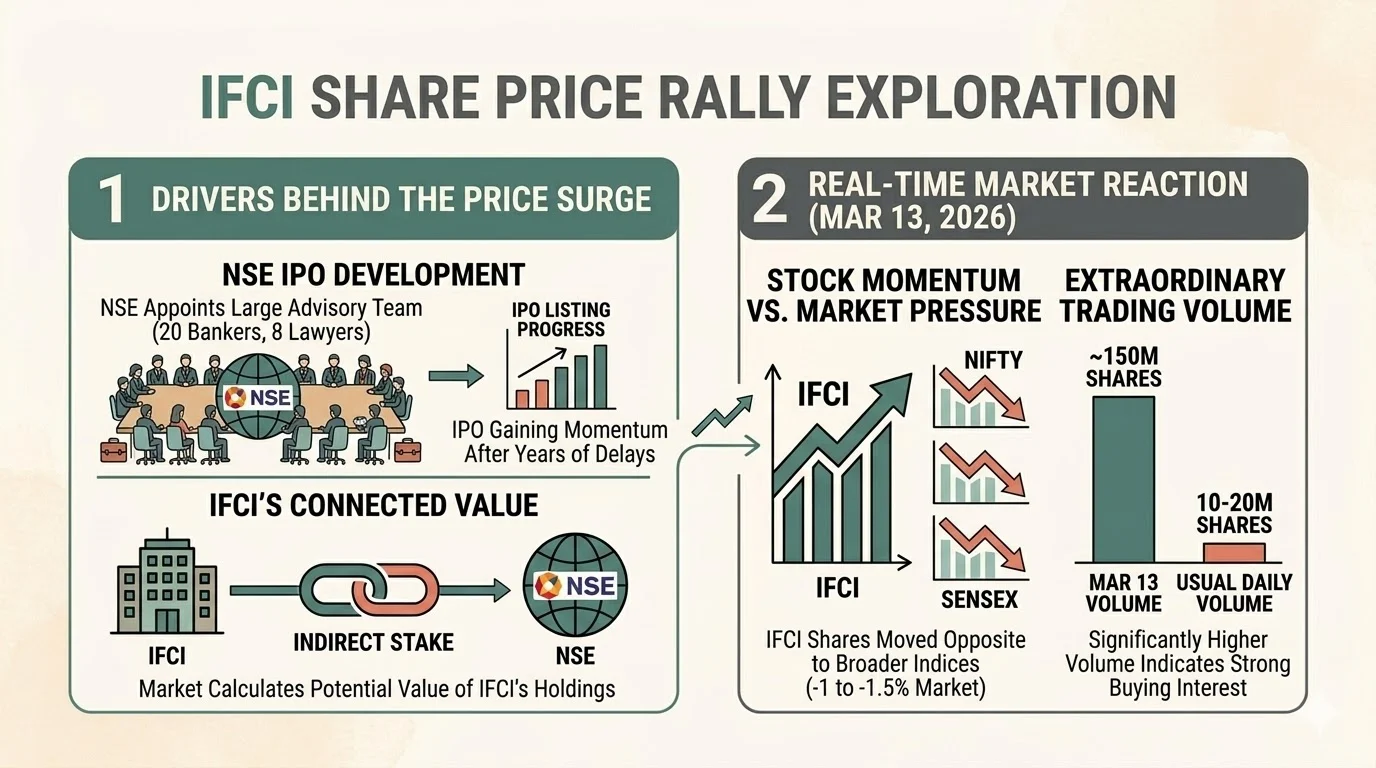
The biggest reason behind the sudden rise in IFCI share price is the latest development related to the National Stock Exchange IPO.
NSE recently appointed 20 merchant bankers and 8 law firms to manage the public offering process. This is one of the largest advisory teams ever appointed for an IPO in India. The appointment of such a large group of advisors indicates that the exchange is serious about moving forward with the listing.
This step is important because the NSE IPO has been delayed for several years. Earlier attempts to list the exchange were paused because of regulatory and governance issues. Now the process appears to be gaining momentum again.
As soon as the news became public, investors started buying shares of companies that have exposure to NSE. IFCI is one of those companies because it has an indirect stake in the exchange.
Whenever a large company prepares for an IPO, stocks that are connected to it often move sharply. The market begins to calculate the potential value of those holdings. That is exactly what happened with IFCI.
Real Time Price Movement And Trading Activity
Another reason the stock gained attention is the strong trading activity during the day. On March 13, 2026 the broader Indian stock market was under pressure. Major indices like Nifty and Sensex were trading lower by around 1 to 1.5 percent. However IFCI moved in the opposite direction and showed strong upward momentum.
The stock saw unusually high trading volume across exchanges. More than 150 million shares were traded during the session. This is significantly higher than the usual daily volume of around 10 to 20 million shares. Such a sharp increase in volume usually indicates strong buying interest from traders and institutions.

Here is a quick snapshot of the market data.
IFCI Market Data On March 13, 2026
- Previous closing price around ₹54
- Intraday high close to ₹59.80
- Nearly 10 to 11 percent intraday gain
- Market capitalization around ₹15,000 to ₹15,500 crore
- Trading volume above 150 million shares
This type of price action usually happens when a strong news trigger enters the market.
How IFCI Is Connected To NSE
Many investors do not realize that IFCI has an indirect exposure to the National Stock Exchange. The connection works through another financial institution called Stock Holding Corporation of India Limited.
Here is the structure that links IFCI to NSE. Shareholding Structure Connecting IFCI To NSE
| Entity | Stake |
|---|---|
| IFCI Stake In Stock Holding Corporation Of India | 52.86 percent |
| Stock Holding Corporation Stake In NSE | About 4.4 percent |
| IFCI Effective Indirect Exposure To NSE | Around 2.3 percent |
Because IFCI owns a majority stake in Stock Holding Corporation of India, the value of SHCIL’s assets directly affects IFCI’s valuation. If NSE gets listed at a strong valuation, the value of SHCIL’s investment in NSE could rise significantly. This indirectly benefits IFCI shareholders. This is the main reason investors suddenly started paying attention to the stock.
NSE IPO Could Unlock Huge Value
One of the biggest reasons for investor excitement is the potential valuation of the National Stock Exchange. In the unlisted market, NSE is already valued close to ₹5 lakh crore. Some transactions in the grey market indicate share prices between ₹1,975 and ₹2,010.
At this valuation level the stake held by Stock Holding Corporation in NSE could be worth more than ₹22,000 crore. Since IFCI owns more than half of SHCIL, its effective exposure could be around ₹11,500 to ₹13,000 crore.
This is a very interesting situation for investors because IFCI’s own market capitalization is around ₹15,000 crore. In simple terms the indirect NSE exposure alone could be close to the entire valuation of IFCI. This is why many market participants are calling IFCI a leveraged play on the NSE IPO story.
If NSE lists at a higher valuation, the potential value unlocking could be even larger.
Government Capital Infusion Strengthening IFCI
Another positive factor for IFCI is government support. The government approved a capital infusion of ₹500 crore into the company through the issuance of preferential shares. This move is intended to strengthen the financial position of the state owned NBFC.
Government backing often improves investor confidence because it signals long term stability and policy support. Since IFCI is a government owned institution, such support can play an important role in improving its balance sheet and growth prospects.
Also Read: Reliance Investment In US Oil Refinery: Trump’s $300 Billion Announcement Explained Simply
Strategic Consolidation Plan For Subsidiaries
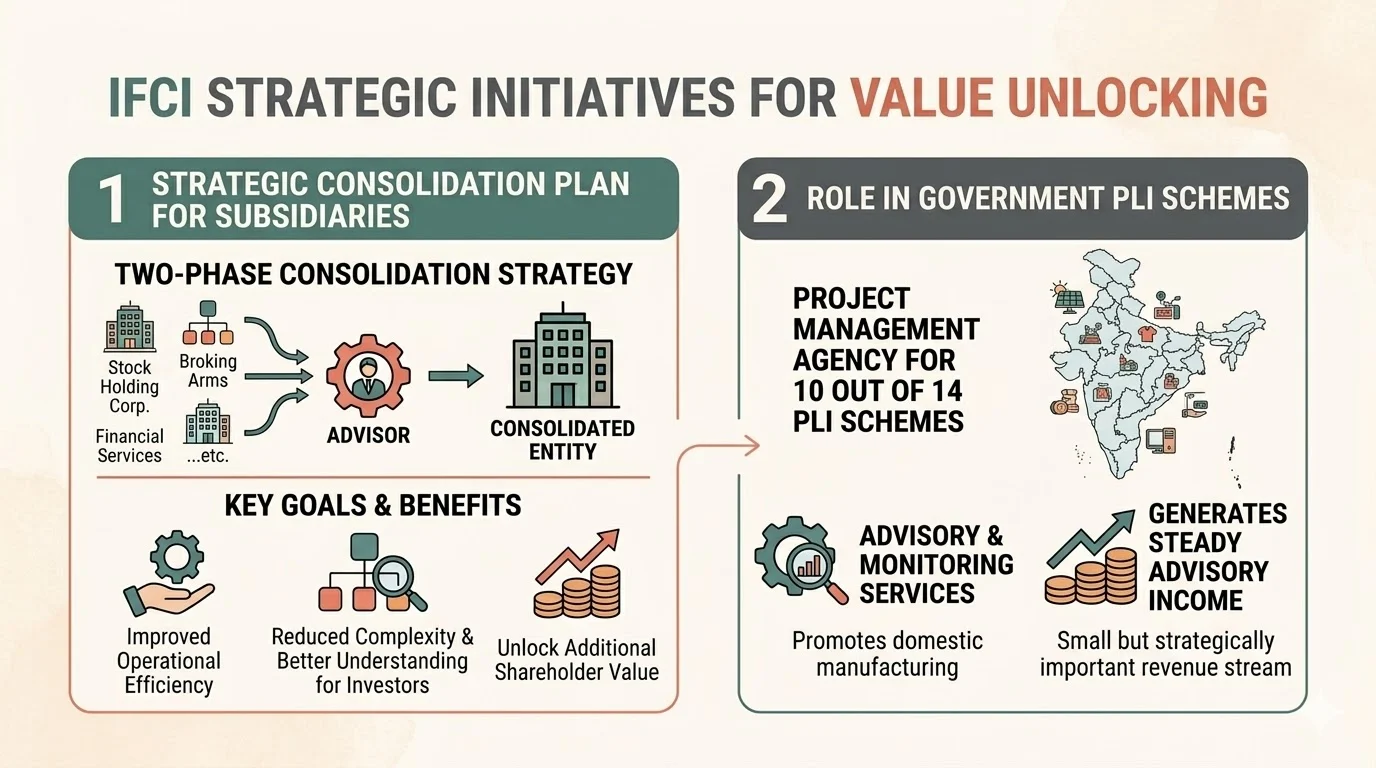
IFCI is also exploring a strategic restructuring plan to simplify its corporate structure. A transaction advisor has proposed a two phase consolidation strategy. Under this plan several subsidiaries could be merged into a single consolidated entity. This restructuring may include companies such as Stock Holding Corporation of India and other broking or financial services arms.
The goal of this consolidation is to improve operational efficiency and reduce complexity. A simpler corporate structure often helps investors understand the company better. Earlier news related to this restructuring proposal had already triggered a rally of around 9 percent in the stock.
If the plan moves forward successfully, it could unlock additional value for shareholders. IFCI Role In Government PLI Schemes. Another factor supporting the company is its role in government programs.
IFCI currently acts as the Project Management Agency for 10 out of the 14 Production Linked Incentive schemes launched under the Atmanirbhar Bharat initiative. These schemes are designed to promote domestic manufacturing and strengthen India’s industrial base. As the project management agency, IFCI provides advisory and monitoring services for these programs.
This role can generate steady advisory income for the company in the coming years. Although this business segment is smaller compared to lending activities, it adds another revenue stream and strengthens IFCI’s strategic importance.
IFCI Core Business & Financial Background
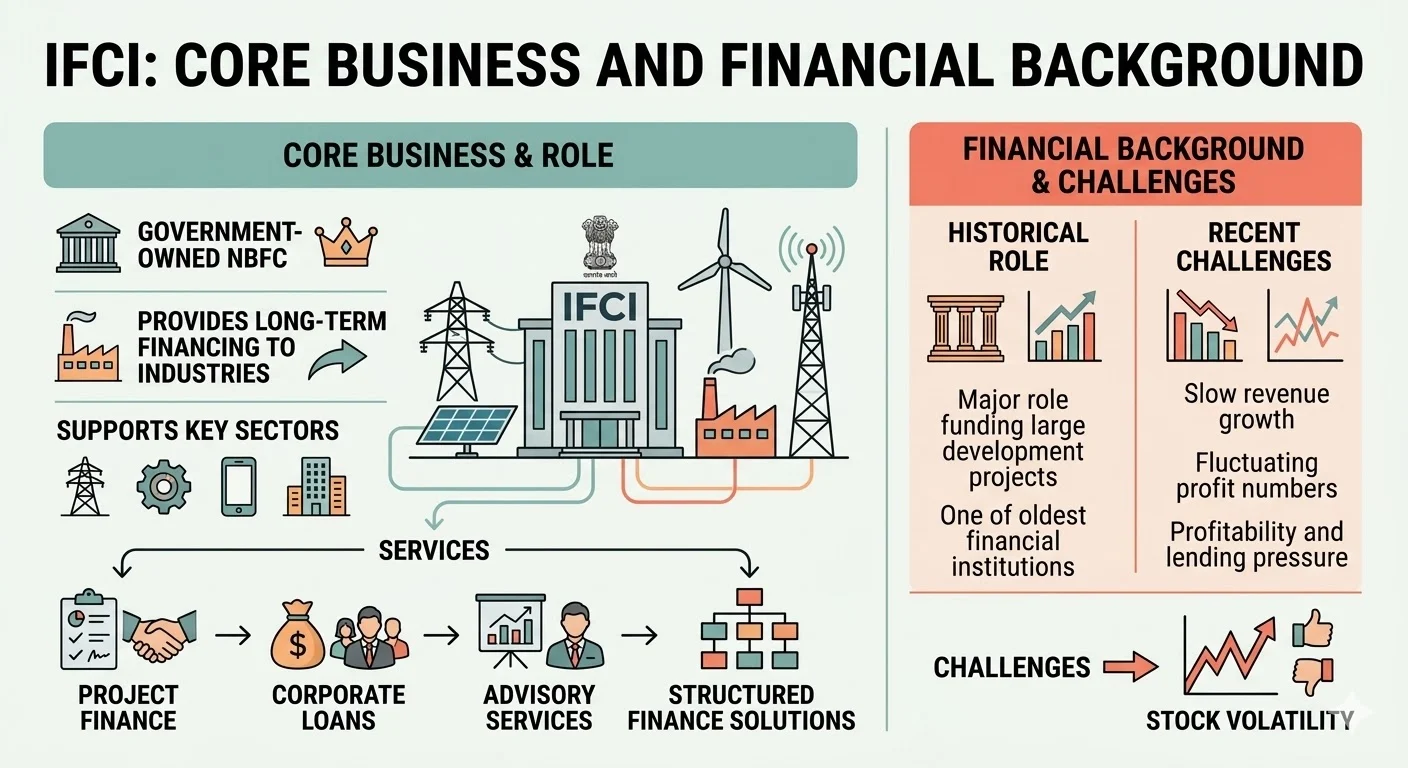
While the recent rally is largely driven by the NSE IPO story, it is also important to understand IFCI’s core business. IFCI is one of the oldest financial institutions in India. The company mainly operates as a government owned NBFC that provides long term financing to industries.
The institution supports sectors such as infrastructure, power, manufacturing, telecom, and real estate. It also provides services such as project finance, corporate loans, advisory services, and structured finance solutions.
Over the decades IFCI has played a major role in funding large development projects across the country. However the company has faced challenges in recent years. Some financial results have shown pressure on profitability and lending growth.
Revenue growth has been relatively slow and profit numbers have fluctuated in some quarters. Because of this the stock has historically been volatile. This is why news related to asset value or strategic holdings often causes large movements in the share price.
Historical Context Of The NSE IPO
The National Stock Exchange IPO has a long and complicated history. The exchange first filed draft documents for an IPO in 2016. However the process was halted due to regulatory investigations related to governance issues.
For several years the listing remained uncertain. In early 2026 the situation changed when regulators provided clearance for the IPO process to move forward. Since then the exchange has been preparing for the public offering again.
The appointment of merchant bankers and legal advisors is usually one of the early steps before filing draft documents with regulators.
If everything proceeds smoothly, NSE may file its draft prospectus soon. Market experts believe the listing could happen by late 2026.
Because NSE is the largest stock exchange in India, its IPO could become one of the biggest public offerings in the history of the Indian market.
Risks Investors Should Understand With IFCI
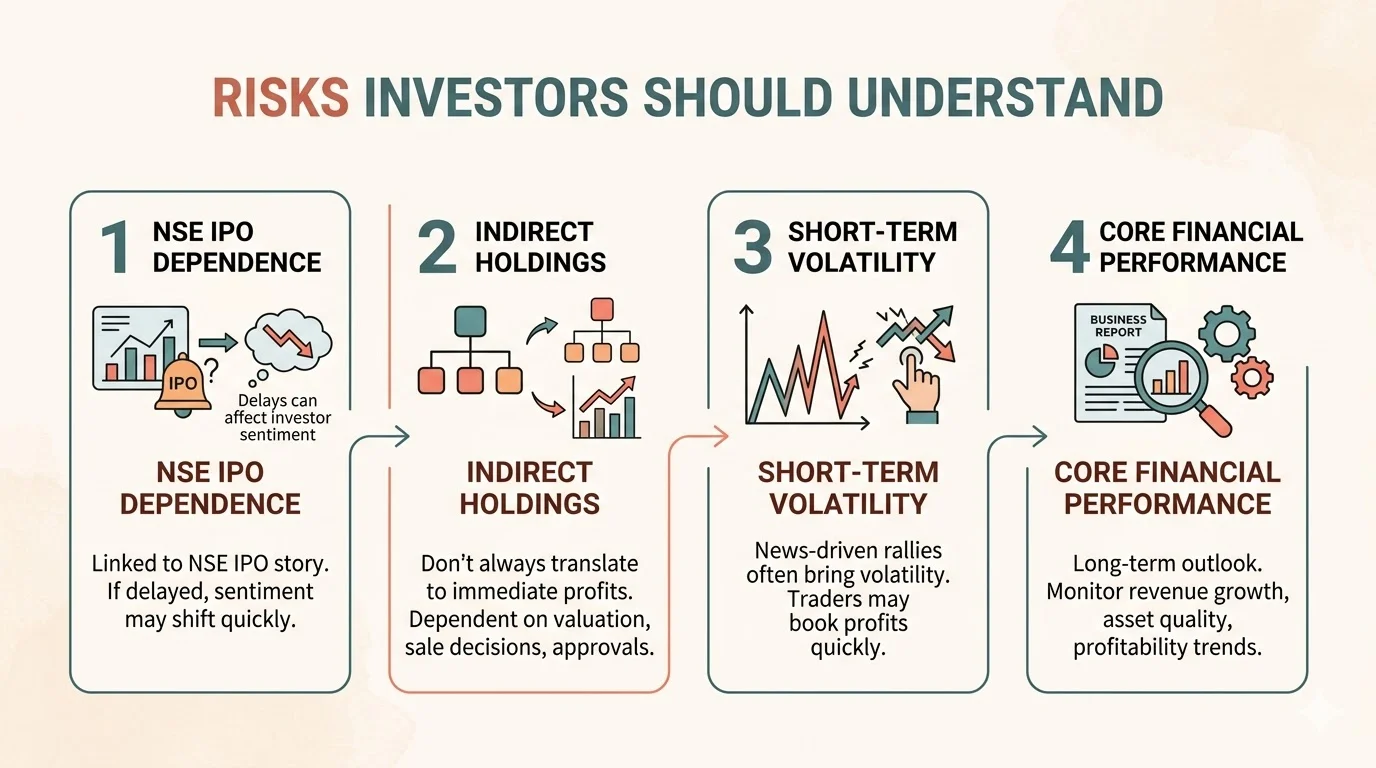
While the IFCI rally looks exciting, investors should also understand the risks involved. First the stock movement is heavily linked to the NSE IPO story. If the IPO faces delays again, investor sentiment may change quickly.
Second indirect holdings do not always translate into immediate profits. The final benefit depends on factors such as listing valuation, stake sale decisions, and regulatory approvals.
Third stocks that move sharply on news often experience short term volatility. Traders may book profits quickly after a strong rally.
Finally the core financial performance of IFCI also matters in the long term. Investors should monitor revenue growth, asset quality, and profitability trends. Understanding these risks helps investors make balanced decisions instead of reacting only to market hype.
What Investors Should Watch Next
Several developments could influence IFCI share price in the coming months. The first major milestone will be the filing of draft IPO documents by NSE. This step will confirm that the listing process is moving forward.
Investors will also watch the valuation at which the exchange plans to list. Higher valuation could increase the perceived value of IFCI’s indirect stake.
Another factor to watch is the progress of IFCI’s restructuring plan. Any merger or consolidation of subsidiaries could unlock additional value.
Quarterly financial results and updates related to government programs may also affect investor sentiment. Because of these factors IFCI is likely to remain in focus for traders and investors throughout 2026.
Conclusion
The sharp rise in IFCI share price is mainly driven by optimism surrounding the upcoming National Stock Exchange IPO. The appointment of merchant bankers and law firms has signaled real progress in the listing process after years of delay.
Since IFCI has an indirect stake in NSE through Stock Holding Corporation of India, investors are expecting a significant value unlocking opportunity if the exchange gets listed at a strong valuation.
Other factors such as government capital support, strategic restructuring plans, and the company’s role in PLI schemes are also improving market sentiment.
However investors should remember that the current rally is largely event driven. Short term volatility is possible as the IPO process continues.
In my opinion IFCI will remain a closely watched stock as long as the NSE listing story stays active. Investors should follow developments carefully and focus on both the opportunity and the risks before making any investment decision.
Related Posts :




Share This Post