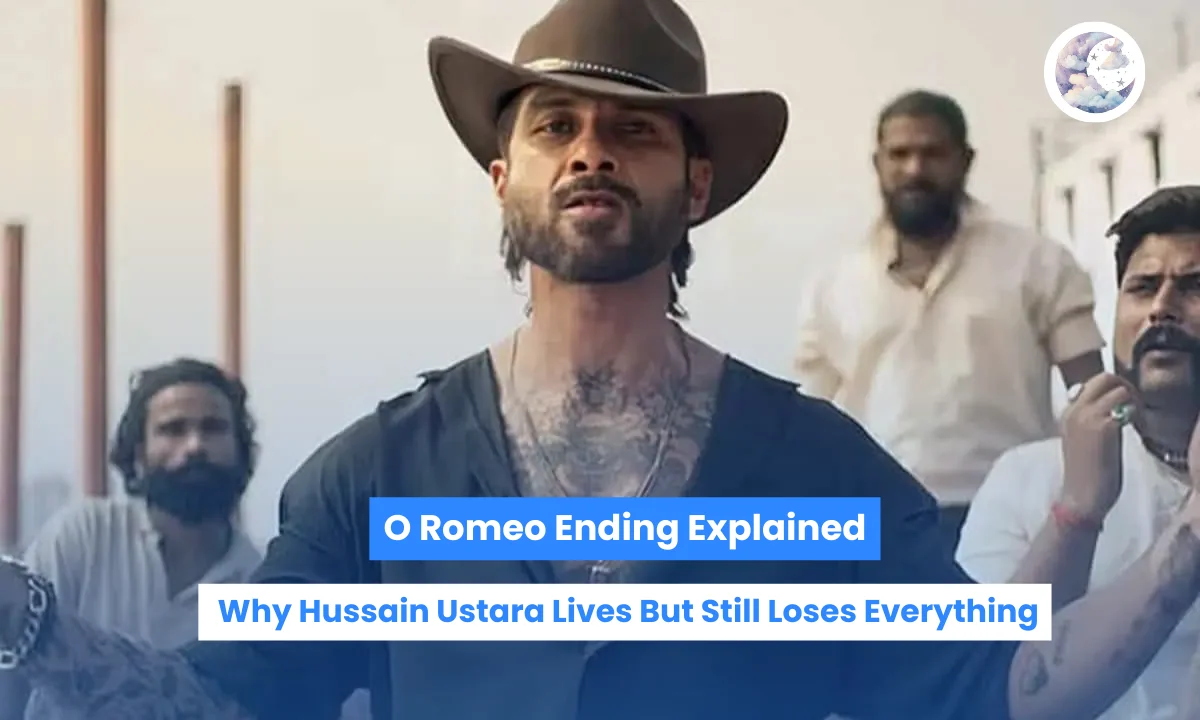
O Romeo Ending Explained: Why Hussain Ustara Lives But Still Loses Everything
O Romeo Ending Explained: Why Hussain Ustara Lives But Still Loses Everything
O Romeo ending explained is trending right now as audiences walk out of theatres trying to process that bittersweet climax. Directed by Vishal Bhardwaj and starring Shahid Kapoor and Triptii Dimri, this 2026 romantic action thriller blends underworld rage with fragile love in a way mainstream Bollywood rarely attempts.
Released on February 13, 2026, just before Valentine’s weekend, the film shocked viewers by subverting the classic Romeo template. This is not a clean love story. This is love soaked in blood, betrayal and consequences. And unlike most commercial romances, it refuses to reward obsession with a fairy tale ending.
For viewers searching O Romeo ending explained, the confusion is understandable. Many reviews praised the performances and criticised the pacing, but very few actually broke down what the finale truly means. Let us walk through the ending in full detail, with spoilers, themes and real life context.
Key Takeaways
- Hussain Ustara does not die in the climax
- The final shootout in Spain kills Ismail Khan but breaks Ustara
- Afsha returns after believing she endangered him
- The ending represents emotional death, not physical death
- The film leaves room for a sequel
- The tragedy is psychological, not Shakespearean
The Context Behind The Ending
O Romeo draws inspiration from a chapter in Mafia Queens of Mumbai by Hussain Zaidi. The film reimagines gangster Hussain Ustara and the Sapna Didi legend into a stylised tragic romance rooted in Mumbai’s underworld history.
In real life, Hussain Ustara was known as a blade wielding gangster who operated in the shadows of larger crime syndicates. He was associated with violent turf wars and complex loyalties, including rivalries linked to Dawood Ibrahim. Sapna Didi, whose real name was Ashraf Khan, reportedly approached Ustara seeking revenge for her husband’s murder. Their real life story was far more complicated and reportedly did not evolve into a sweeping romance. There were allegations of discomfort and personal boundaries that led to distance rather than union.
Bhardwaj does not retell history directly. He reshapes it. He blends poetic violence with a revenge arc and adds his signature moral grey zones. Instead of focusing on crime politics alone, he reframes the narrative as a love story infected by revenge.
The runtime of nearly three hours builds toward one key question. Is love powerful enough to redeem a violent man, or does obsession destroy everything it touches.
To understand the ending, we need to break down the final act step by step.
Detailed Ending Breakdown – Full Spoilers
Before we go further, this section contains complete spoilers of the climax.
The final act begins with emotional fracture, not gunfire. Afsha, realising the scale of chaos unleashed by her revenge alliance with Ustara, decides to flee. She believes her presence has made him vulnerable and that staying will only ensure his death. This decision is crucial because it removes the emotional anchor from Ustara just before his biggest confrontation.
Meanwhile, Ismail Khan, the mentor turned enemy, retreats to Spain. His base of operations is a converted bullfighting arena, designed visually like a ritual battlefield. Bhardwaj frames this location as symbolic execution. The bull is cornered. The matador performs. Blood is spectacle.
Ustara travels there alone, already stripped of allies. Former associates have either betrayed him or been killed. His underworld empire has collapsed due to his reckless prioritisation of Afsha over business discipline. He enters the arena not as a kingpin but as a wounded animal.
The shootout is brutal and stylised. Gunfire echoes through the empty stands. Several henchmen fall in operatic slow motion. The background score carries echoes of Bhardwaj’s theatrical intensity. At the centre stands Khan, representing the old order of crime, mocking Ustara for choosing love over power.
Ustara kills Ismail Khan. The revenge is complete.
But victory lasts seconds.
He is shot multiple times during the exchange. Blood spreads across the sand of the arena. He collapses. The camera lingers long enough for audiences to assume he is dead. It mirrors Shakespearean inevitability.
However, the film refuses that closure. He survives.
The next sequence shifts to a hospital recovery setting. Ustara is alive but broken, physically weakened and emotionally hollow. News reports label him a fugitive. His networks are dismantled. His wealth is inaccessible. The gangster who commanded fear is now dependent and hunted.
Afsha learns he survived and returns quietly. There is no dramatic reunion music. No celebratory embrace. She stands beside a man who has sacrificed everything and gained nothing tangible.
The final dialogue hints at uncertainty rather than triumph. They are together, but at enormous cost. The world they knew is gone.

The Spain Arena Showdown Explained
The arena setting is not random spectacle. In traditional bullfighting, the bull is provoked, exhausted and ultimately killed for display. Bhardwaj inverts this metaphor.
Ustara is both bull and matador. He enters with rage, kills his opponent, yet emerges mortally wounded. The sand soaked in blood visually reinforces the cost of pride and obsession.
Critics who called the film all style and no sting often missed this layered symbolism. The setting externalises Ustara’s internal collapse. His identity as a gangster depends on dominance. In Spain, he wins the duel but loses the war within himself.
Why Ustara Surviving Is The Real Tragedy?
Most viewers expected a classic Romeo style death. Instead Bhardwaj flips the trope.
In Romeo and Juliet, love culminates in mutual death, sealing devotion in tragedy. O Romeo does something arguably darker. It allows the man to live.
Ustara survives physically. But emotionally, he is finished.
He has betrayed mentors. Destroyed alliances. Triggered bloodshed that dismantled his own empire. Afsha becomes a fugitive because of him. His criminal identity collapses.
This is a pyrrhic victory. He wins revenge but loses power, status and self definition.
The survival is hollow. Death would have romanticised him. Survival forces him to confront consequence.
That is the subversion.
Love As Destruction Not Redemption
One major criticism across reviews is that the romance feels abrupt or underdeveloped. Viewers expected deeper emotional layering before the explosion of violence.
But that perceived weakness actually feeds into the ending’s meaning.
The film frames love as obsession. Ustara falls intensely and irrationally. His decisions become impulsive. He risks business stability for emotional loyalty. The romance is not patient or mature. It is combustible.
Because the foundation is unstable, the collapse feels sudden. The ending reveals that this was never redemptive love. It was destructive attachment disguised as salvation.
When he wakes up broken, love has not saved him. It has stripped him.
Afsha’s Return And What It Means
Afsha initially runs away believing she endangered him. Her revenge against larger crime forces triggered a chain reaction. She sees herself as the curse in his life.
Her return is quiet and heavy. She does not return to celebrate victory. She returns to witness what remains.
She sees a man stripped of ego and stripped of violence. The swagger is gone. The poetic rage that defined his identity has faded.
Importantly, the film does not transform her into a stereotypical gangster queen. Unlike mythologised underworld romances, she remains emotionally grounded. Her arc is about agency and grief, not domination.
Their union at the end is not glamorous. It is fragile.
Real Life Inspiration Versus Film Fiction
The film takes major liberties with history.
Real accounts of Hussain Ustara describe a volatile gangster navigating shifting loyalties. Sapna Didi’s story in Mafia Queens of Mumbai is rooted in revenge, not epic romance. Their association reportedly fractured due to personal boundaries rather than tragic destiny.
The film amplifies romance and tragedy to centre Ustara as a fallen lover rather than merely a criminal operator. It shifts focus from organised crime politics to emotional ruin.
This fictionalisation has sparked debate among those familiar with underworld lore. Some argue the romantic angle oversimplifies complex real events. Others appreciate the artistic reinterpretation.
Regardless, the ending clearly prioritises emotional myth over factual biography.
Comparison With Bhardwaj’s Earlier Work
Fans are comparing O Romeo with earlier collaborations between Bhardwaj and Kapoor such as Haider and Kaminey.
Haider embraced existential tragedy and political commentary. Kaminey explored duality and moral ambiguity. O Romeo leans more into mainstream spectacle, with heightened violence and commercial pacing.
Yet the ending attempts to reclaim arthouse depth by denying easy closure. Like Haider, it leaves its protagonist alive but spiritually altered. Like Kaminey, it explores fractured identity.
The difference lies in tone. O Romeo disguises tragedy as mass entertainment before revealing emotional emptiness in the final minutes.
Audience And Critic Reactions To The Ending
While many mainstream reviews focused on pacing or tonal imbalance, audience reactions to the ending are more polarised.
Some viewers praised the bold decision to let Ustara live, calling it a bittersweet anti Valentine twist. They argue that survival makes the tragedy more mature and less melodramatic.
Others felt unsatisfied after investing nearly three hours into a revenge arc that concludes without emotional catharsis. For them, the romance did not earn such devastation.
Interestingly, even critics who labelled the screenplay uneven admitted the final act had intensity. The Spain shootout and hospital aftermath are consistently cited as the film’s strongest stretch.
The duality is clear. Heroic on the surface. Tragic underneath.
Box Office And Commercial Stakes
The film reportedly carries a budget between 75 and 80 crore. Advance bookings showed strong urban turnout, particularly in metro cities. Positioned opposite Tu Yaa Main, it targeted audiences seeking darker romance rather than light escapism.
Word of mouth is passionate rather than neutral. That intensity often determines longevity at the box office.
Whether it crosses the 100 crore mark depends on repeat viewing and sustained debate around its ending.
Frequently Asked Questions
Does Hussain Ustara die in O Romeo
No. He survives the Spain shootout despite being shot multiple times. However, his gangster identity effectively dies. He loses power, influence and purpose.
Why does the ending feel tragic if he lives
Because the film frames identity loss as worse than death. He survives physically but loses everything that defined him.
Is the film setting up a sequel
The open ended final dialogue and unresolved fugitive status suggest potential continuation. Nothing is officially announced, but the narrative leaves room.
How accurate is the film to real events
It is loosely inspired by real underworld figures but heavily fictionalised, especially in terms of romance and dramatic climax.
When will O Romeo release on OTT
Industry patterns suggest a streaming release window of 45 to 60 days after theatrical debut. Platforms like Amazon Prime Video are often associated with such deals, though official confirmation is awaited.
The Real Meaning Of The Ending
O Romeo is not about whether Hussain Ustara dies.
It is about what love costs when fused with revenge.
He wins revenge. He loses identity.
He saves Afsha. He destroys his empire.
He survives bullets. He cannot survive consequences.
By allowing him to live, Bhardwaj denies the audience romantic martyrdom. Instead, he forces confrontation with emotional erosion. That choice transforms a commercial action thriller into a cautionary tale about obsession.
Final Verdict On The Ending
The climax is not designed to please everyone. It is designed to unsettle.
If you expected a grand sacrifice, you may feel deprived. If you recognise tragedy as the slow stripping away of self, the ending resonates more deeply.
O Romeo closes not with applause but with silence.
That silence is the point.
Tags: O Romeo ending explained, Shahid Kapoor O Romeo, Vishal Bhardwaj film analysis, Hussain Ustara real story, Triptii Dimri Afsha, O Romeo review, O Romeo climax breakdown, Bollywood 2026 thriller
Related Posts :

Share This Post