Pakistan Misadventure Warning by Rajnath Singh: What It Means & Why It Matters Right Now
Pakistan Misadventure Warning by Rajnath Singh: What It Means & Why It Matters Right Now
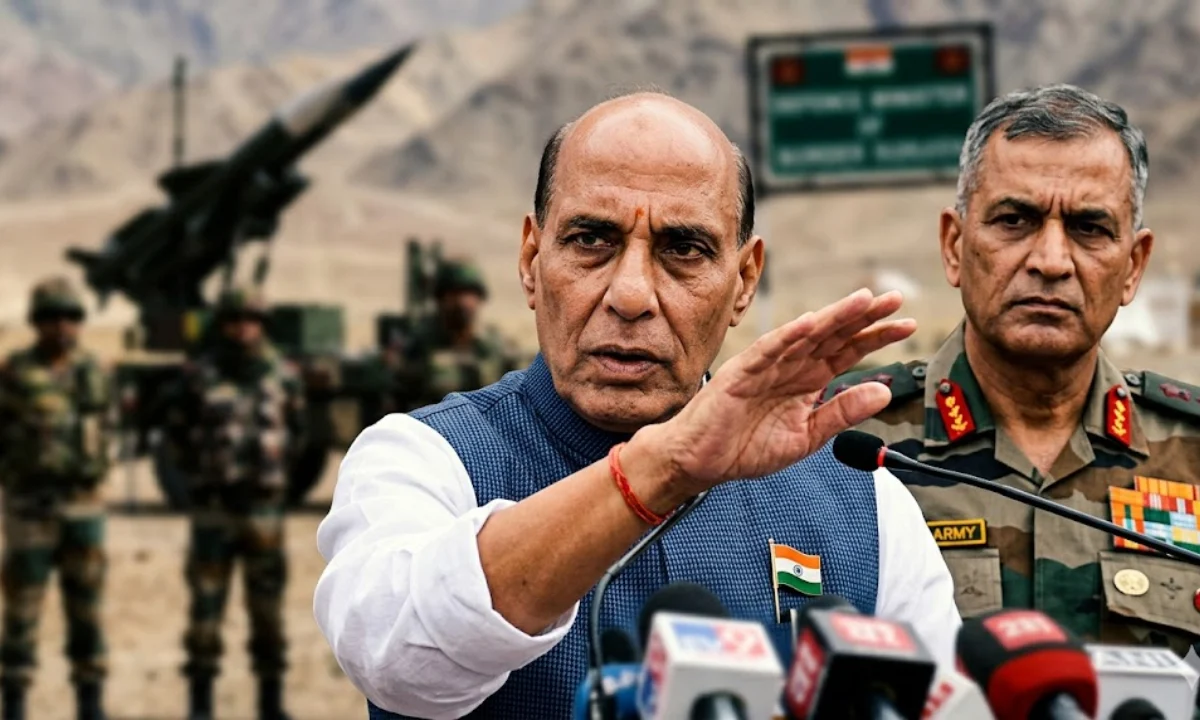
India’s Defence Minister Rajnath Singh issued one of the strongest warnings to Pakistan in recent times on April 2, 2026. Speaking at a Sainik Samman Sammelan event in Thiruvananthapuram, Kerala, he said that any “misadventure” from Pakistan in the current situation will invite “unprecedented and decisive” action from India. This statement is not coming from nowhere. It is backed by a full year of military preparedness, a completed but “ongoing” operation, rising global tensions, and a changed security doctrine in India.
If you want to understand what this warning means, why it came now, and what could happen next, this article covers everything in simple and clear language.
Table of Contents
What Is the Meaning of “Misadventure” in This Context
The word “misadventure” is being used to describe any aggressive, provocative, or destabilizing action that Pakistan might take. This includes cross-border terrorism, drone intrusions, support to militant groups, or any attempt to exploit the ongoing global crisis in West Asia.
Rajnath Singh said clearly: “Our neighbour, in the current situation, can commit any misadventure. If it does so, India’s action will be unprecedented and decisive.”
The phrase “unprecedented” is very important here. India has already carried out surgical strikes after the Uri attack in 2016 and air strikes after the Pulwama attack in 2019. The word “unprecedented” signals that any future response will go beyond what Pakistan has experienced so far.
This is not just political messaging. It is a public warning backed by real military capability and recent operational history.
Why Did Rajnath Singh Give This Warning on April 2, 2026
Timing explains a lot.
April 2 falls just days before the first anniversary of the April 22, 2025 Pahalgam terror attack. That attack killed 26 tourists in Kashmir and directly led to Operation Sindoor. Rajnath Singh’s statement is both a reminder of India’s resolve and a signal to Pakistan that India remains in a state of readiness.
But there is a bigger context as well.
The West Asia conflict is ongoing, and India is closely monitoring the situation. The Defence Minister reminded that Operation Sindoor is not over yet and that India was fast becoming self-reliant in defence.
Singh noted that the evolving global situation could create opportunities for adversaries to act recklessly. He asserted that India is ready to respond firmly to any provocation.
Pakistan has also been behaving in ways that have raised concern. When the US and Israel struck Iran in February 2026, Pakistan declared open war with Afghanistan without any obvious trigger. Security experts believe Pakistan’s army chief Asim Munir was trying to avoid being pulled into the Iran war due to Pakistan’s defence pact with Saudi Arabia. This kind of unpredictable behavior is exactly what Rajnath Singh appears to be warning against.
Also Read
Reliance Investment In US Oil Refinery: Trump’s $300 Billion Announcement Explained Simply
Operation Sindoor: The Event That Changed India’s Security Response
To understand the depth of this warning, you need to know what Operation Sindoor actually was and what it achieved.
What Triggered It
The crisis emerged after the Pahalgam terrorist attack. India accused Pakistan of sponsoring the militants. Pakistan denied its involvement and said it would cooperate with an international inquiry.
Before the military operation began, India took a series of strong steps. India expelled Pakistani diplomats, recalled its own staff, stopped visa services, and suspended the Indus Waters Treaty. This was one of the strongest sets of diplomatic actions India had taken since 1971.
What Happened During the Operation
On the night of May 7 to 8, 2025, the Government of India executed Operation Sindoor. The response was non-escalatory, precise, and targeted terrorist training camps at nine different locations within Pakistan and Pakistan Occupied Kashmir. No military targets were engaged.
Nine terror camps were eliminated. India successfully destroyed nine major terror launchpads in Pakistan and PoK, targeting Lashkar-e-Taiba, Jaish-e-Mohammed, and Hizbul Mujahideen facilities. Over 100 terrorists were killed in action.
The operation targeted some of the most well-known and protected terror infrastructure in Pakistan. The Jaish-e-Mohammed headquarters in Bahawalpur and the Lashkar-e-Taiba training facility in Muridke were among the targets. Both of these locations had been considered untouchable for decades.
The strikes represent perhaps the most significant and daring military action by India on Pakistani targets since the Bangladesh Liberation War of 1971. The five-day conflict played out between May 6 and May 10, 2025.
Pakistan’s Response and the Ceasefire
In the early hours of May 8, Pakistan launched coordinated drone and missile strikes targeting over a dozen Indian military installations across the Northern and Western theatres, including Srinagar, Jammu, Pathankot, Amritsar, Ludhiana, Bathinda, and Bhuj.
India responded by expanding the operation to strike Pakistani airbases. India carried out air strikes on 11 airbases of Pakistan. This led to the destruction of 20 per cent of Pakistan’s Air Force assets.
Pakistan’s Director General of Military Operations then called India’s DGMO and requested a ceasefire. The hostilities ended after Pakistan sought a ceasefire on May 10.
The Navy Was Minutes Away From Striking
One of the most significant revelations came just a day before Rajnath Singh’s warning. Navy Chief Admiral Dinesh K Tripathi disclosed something that had not been public before.
Admiral Dinesh Tripathi said: “It is not a hidden fact anymore that we were just minutes away from striking Pakistan from sea, when they requested the stoppage of kinetic actions.”
This means Pakistan was facing a three-front military situation: air strikes, army engagement, and a naval strike that nearly happened. This disclosure is a strong part of why Rajnath Singh’s warning carries so much weight right now. India is signaling that it had more firepower in reserve and it will not hesitate to use it next time.
Key Facts About Operation Sindoor
Here is a summary of the key verified facts from Operation Sindoor:
| Fact | Detail |
|---|---|
| Date launched | Night of May 7 to 8, 2025 |
| Trigger event | Pahalgam terror attack, April 22, 2025 (26 killed) |
| Number of targets hit | 9 terror camps in Pakistan and PoK |
| Terror groups targeted | Lashkar-e-Taiba, Jaish-e-Mohammed, Hizbul Mujahideen |
| Terrorists killed | 100+ (per Indian government statements) |
| Duration of first strikes | 23 minutes |
| Pakistan’s response | Drone and missile strikes on Indian bases |
| Indian counterstrike | 11 Pakistani airbases hit, 20% of Pakistan Air Force assets destroyed |
| Ceasefire date | May 10, 2025 at 5 PM IST |
| Naval readiness | Indian Navy was minutes from launching sea strikes |
| Current status | Operation declared “not over” by Defence Minister |
This table shows that Operation Sindoor was not a short and symbolic gesture. It was a full multi-service military campaign that involved the Army, Air Force, and Navy working together. The ceasefire came because Pakistan requested it. India did not stop because of external pressure or its own limitations.
This context is what makes Rajnath Singh’s April 2026 warning significant. He is not making an empty threat. He is referring to an operation that actually happened, that Pakistan felt, and that India says is still active.
India’s Changing Approach to Cross-Border Terrorism
One of the clearest patterns in the last decade is how India’s response to terrorism has evolved. Each response has been stronger and faster than the last.
2016 Uri Attack: India conducted surgical strikes on terror launch pads across the Line of Control. This was India’s first publicly acknowledged cross-LoC military action and broke the old pattern of diplomatic protest only.
2019 Pulwama Attack: India carried out air strikes inside Pakistani territory in Balakot. This was India’s first air strike inside Pakistan since the 1971 war. It crossed a major threshold.
2025 Pahalgam Attack: India launched Operation Sindoor with strikes deep inside Pakistan’s Punjab province, including Bahawalpur and Muridke. India struck deep into Pakistan’s heartland, including Punjab province and Bahawalpur, once considered out of bounds even for US drones.
The escalation ladder is very clear. Each response was larger, deeper, and more damaging than the previous one. When Rajnath Singh says “unprecedented,” he is pointing to this pattern. The next response, if it comes, will logically be even more significant.
Rajnath Singh said India now has zero tolerance against terrorism under Prime Minister Modi’s leadership. He added that the country has taken action against terrorism on both sides of the border.
India’s Growing Defence Strength: The Numbers Behind the Warning
Words alone do not make a credible deterrent. What gives this warning real weight is India’s rapid military and defence manufacturing growth.
India’s defence exports reached a record Rs 38,424 crore in the financial year 2025-26. The figure represented a 62.66 per cent increase over the previous financial year.
This is a remarkable number. India’s defence exports stood at just around Rs 600 crore in 2014. In just over a decade, this has grown to nearly Rs 38,500 crore. The government has set a target of Rs 50,000 crore in defence exports by FY 2029-30.
India’s indigenous defence production reached a record Rs 1,27,434 crore in FY24, registering a 174% rise from Rs 46,429 crore in FY15.
India is exporting defence equipment to more than 80 countries as of FY 2025-26. The number of Indian exporters are now 145.
Rajnath Singh also confirmed that India’s defence production has already crossed the milestone of Rs 1.5 lakh crore, and the aim is to increase it to Rs 3 lakh crore by the end of 2029.
The Indian Navy has been tasked with safely escorting tankers through the Strait of Hormuz, the crucial oil transit point that has become a centre of the West Asia conflict. Here is a quick look at India’s defence export growth:
| Financial Year | Defence Exports (Rs Crore) |
|---|---|
| FY 2014 (base year) | ~600 |
| FY 2023-24 | 21,083 |
| FY 2024-25 | 23,622 |
| FY 2025-26 | 38,424 |
The jump from FY25 to FY26 alone is Rs 14,802 crore. This is not just a number. It reflects growing global trust in India’s military manufacturing. Countries are buying Indian defence equipment because they see it work in real conflict situations like Operation Sindoor.
Why Pakistan Might Be Tempted to Act Now
Understanding why India is issuing this warning now also requires understanding Pakistan’s current situation.
Pakistan is dealing with serious problems at home. The IMF has flagged deep-rooted corruption, weak institutions, and low tax collection. Pakistan’s economy has needed repeated bailout programs. The ongoing Iran-West Asia conflict has created energy price pressures that hit Pakistan hard.
Pakistan’s military suffered visible setbacks after Operation Sindoor. According to India’s Chief of Defence Staff General Anil Chauhan in July 2025, Operation Sindoor allowed significant space for conventional operations. Pakistan’s military had to undertake restructuring after the operation.
At the same time, the West Asia crisis has created a distraction for global powers who would otherwise monitor India-Pakistan tensions closely. An unstable global environment can sometimes make smaller countries take risks that they would not take in normal times. This is exactly the scenario Rajnath Singh appears to be warning against.
Pakistan has also been trying to position itself as a mediator in the Iran conflict. Iran has publicly rejected Pakistan’s mediation claims, which left Pakistan’s government in an embarrassing position. Internal political pressure and external embarrassments sometimes lead to attempts at external distraction. Cross-border terrorism has historically been one such tool.
India’s Energy Security During the West Asia Crisis
One part of Rajnath Singh’s speech that received less attention was his comments on energy security. This is an important part of the complete picture.
Rajnath Singh said: “Some people want to cause panic by spreading lies over this conflict in West Asia. Neither is there a shortage of petrol-diesel in the country, nor a shortage of gas. India is prepared to handle any energy crisis.”
The Strait of Hormuz is the world’s most critical oil transit point. Nearly 20% of the world’s oil passes through it. With the Iran conflict ongoing, there are legitimate concerns about supply disruption. India is directly addressing these concerns by having its Navy escort oil tankers through this route.
This matters because it shows India is not just managing the Pakistan threat. It is simultaneously managing energy security for its citizens and protecting its economic interests in the Gulf. The government is sending a clear message that it can handle multiple crises at the same time.
India’s Non-Military Response: What Happened to Indus Waters and Trade
The response to the Pahalgam attack was not just military. India used all tools available to put pressure on Pakistan.
India suspended the Indus Waters Treaty, expelled Pakistani diplomats, recalled its diplomatic staff, cut off visa services, and cancelled previously issued visas. Pakistan initially responded with trade restrictions, closure of airspace and border crossings, and suspension of the Shimla Agreement.
The Indus Waters Treaty has been one of the longest-standing agreements between India and Pakistan. Suspending it was a signal that India is willing to use every lever available when it believes Pakistan is sponsoring terrorism. This kind of comprehensive pressure, combining military action with diplomatic and economic tools, is what makes India’s current position so strong.
What “Operation Sindoor is Not Over” Actually Means
Many people are trying to understand what Rajnath Singh means when he says Operation Sindoor is not over. This does not necessarily mean active military operations are continuing right now.
What it more likely means is that India has changed its strategic posture permanently. Operation Sindoor drew a new red line: if terror is state policy, it will be met with a visible and forceful response. This marked a shift from deterrence to direct action.
In simple terms, the old rules are gone. India used to respond to terror attacks with diplomatic protests and dossiers. That era ended after Uri. After Pahalgam, India demonstrated that it will strike deep inside Pakistan if needed. Saying the operation is “not over” means this posture is permanent. India is not going back to the old way of responding.
India’s Chief of Defence Staff General Anil Chauhan said: “There is increased propensity amongst nations and governments to use force because political objectives today can be achieved by short duration conflicts. Precision strikes create very little collateral damage, hence the cost of war for nations is less.”
Public Sentiment: How Indians Are Reacting
Social media and news platforms show a very clear trend in public opinion on this topic.
Most Indians are expressing strong support for the government’s firm stance. The response to Operation Sindoor was seen as proof that India could act decisively without getting into an uncontrolled escalation. The ceasefire, which came after Pakistan requested it, is seen as a point of national pride.
There is also curiosity about what “unprecedented” means. People are asking whether a future response could involve sustained strikes on Pakistani military infrastructure, economic targets, or even naval blockades. Rajnath Singh’s mention of the Navy being “minutes away” from striking has added fuel to this curiosity.
Some voices are urging caution and asking for more dialogue. But these are in the minority in current public discourse.
What to Watch For in the Coming Weeks
As the anniversary of the Pahalgam attack approaches, here are the key developments worth watching:
India-Pakistan border activity: Any unusual movement of troops or drone activity near the Line of Control or the international border will be an early indicator of rising tension.
Pakistan’s political statements: Pakistani officials have responded to India’s warnings. Leaders like Khwaja Asif have claimed Pakistan will also respond “swiftly and decisively” to any Indian action. These statements are mostly domestic messaging but they do reflect the temperature on that side.
Global pressure and mediation: The US played a role in the May 2025 ceasefire. Whether global powers will try to intervene if tension rises again is an open question. India has maintained that it reached the ceasefire directly with Pakistan, not through third-party mediation.
Energy situation in West Asia: If the Iran conflict escalates and oil supply is disrupted further, India’s attention and resources may be pulled in multiple directions. Pakistan might view this as a window of opportunity.
India’s defence procurement: India recently cleared a procurement of 114 Rafale jets and other military hardware worth Rs 3.60 lakh crore. This signals that India is continuing to invest in long-term military modernization regardless of short-term tensions.
Summary: Is There an Immediate Threat
Based on all the evidence available right now, the situation is tense but there is no confirmed immediate conflict.
Rajnath Singh’s warning is a deterrent message. It is designed to prevent Pakistan from taking any action rather than to announce that action is imminent. The strength of a deterrent is that it works best when it does not have to be used.
India has demonstrated through Operation Sindoor that it is willing and able to act. It has demonstrated through the naval readiness disclosure that it held back significant firepower even during the operation. And it is now clearly signaling that the next response will be even stronger.
Pakistan knows this. That is why the ceasefire request came from Pakistan’s side in May 2025, not from India’s.
The coming weeks around the Pahalgam attack anniversary will be a sensitive period. India’s security agencies are clearly on high alert. The government is making sure Pakistan knows the cost of any miscalculation. For ordinary citizens, the best approach is to stay informed, avoid panic based on social media rumors, and understand that India’s security establishment is functioning with full awareness of the situation.
Related Posts :



Share This Post